In brief
Moerdijk, a quaint village in the Netherlands with a population of about 1,100, is threatened with demolition as the government seeks land for energy infrastructure. Positioned near key transportation routes and ports, it has been identified as a prime location for substations to connect offshore wind energy to the national grid. Local fishermen and residents question the environmental costs of sacrificing their community for the country's green energy ambitions.
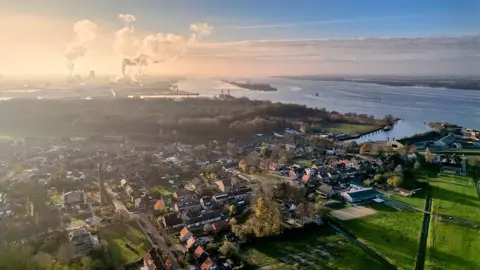
In the south of the Netherlands, beside a wide estuary, a village of around 1,100 people is likely to disappear from the map.
Moerdijk, a small fishing community 34km (21 miles) south of Rotterdam, is on the fault line of the nation's green energy transition. The Dutch government says the country needs vast new sites to build high-voltage substations where cables carrying electricity from growing offshore wind farms can be connected to the national grid.
Yet the Netherlands is short of land. Officials argue that Moerdijk, which is on the southern shore of the Hollands Diep estuary, and well located next to ports, motorways, and existing overhead power lines, is a prime location for such a facility.
So the residents face the real threat of seeing their homes demolished at some point in the next decade, and the village potentially vanishing.
We are being brought to the slaughter house, says fishmonger Jaco Koman. His family has trawled for their livelihoods here since 1918, and Koman's company still keeps live eels for smoking - a traditional Dutch delicacy - and supplying high-end restaurants across the country. The industry, Koman says, much like his latest catch, is thriving. Yet the deep water and open land that sustain his livelihood are part of what make Moerdijk so attractive to planners.
When residents first heard the news, Koman remembers everybody was shocked. His voice cracks, It was really, really terrible. The prospect now is that not just his business, but his home on the other side of the dyke that protects the village from the water, could be lost.
In Moerdijk, that dilemma is no longer abstract; it's immediate, and it is set to reshape the lives of Jaco, Andrea, Jacques and everyone living on the fault line of the green transition.
For now, they are living with the uncertainty of knowing that the village they wake up in today may one day exist only on old maps – and in their memories.