In brief
Hezbollah is increasingly utilizing small first-person view (FPV) drones to conduct strikes against Israeli military targets. These drones, capable of evading conventional defenses and made from accessible components, represent a tactical evolution for the group. Analysis reveals challenges for the Israel Defense Forces as they struggle to counteract these new threats, leading to a shift in military operations on both sides.
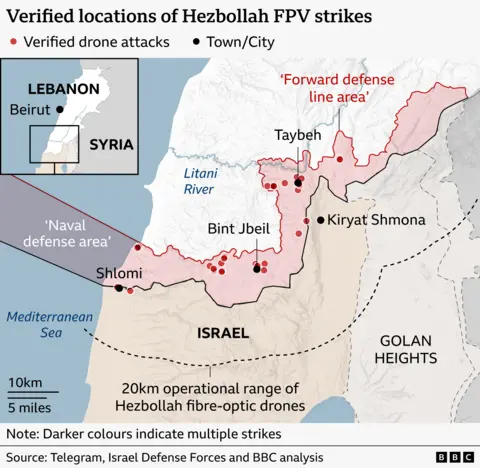
Hezbollah has increased its use of small first-person view (FPV) drones in their attacks against Israel, including advanced systems that use fibre-optic cables to elude sophisticated military defenses.
Since March 26, BBC Verify has identified and geolocated 35 videos released by the Lebanese armed group depicting strikes on Israeli soldiers, armoured vehicles, and air defense systems in both southern Lebanon and northern Israel.
Experts suggest that the Israel Defense Forces (IDF) have been unable to establish effective countermeasures against these small drones that can easily bypass current detection systems.
Manufactured from readily available and 3D-printed materials, these drones offer a budget-friendly method for Hezbollah to strike high-value targets, a tactic that has gained traction during the Russia-Ukraine conflict.
Reports indicate casualties from FPV strikes, including four IDF soldiers and one civilian, with numerous others wounded. The IDF states they are aware of the drone threat and is dedicating significant resources to enhance their defenses and soldier training.
As the conflict continues, military analysts note that Hezbollah's use of FPV drones—including hundreds in their arsenal—introduces a new and difficult-to-counter tactic in warfare.
This military escalation began following the recent killing of Iranian Supreme Leader Ayatollah Ali Khamenei, prompting retaliatory strikes by Hezbollah and subsequent Israeli military responses that have resulted in severe casualties for both sides.