In brief
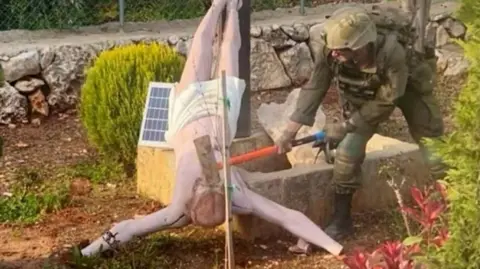
Two Israeli soldiers have been punished with military detention after hitting a statue of Jesus with a sledgehammer in southern Lebanon. The IDF announced the punishment following an inquiry, stating the soldiers displayed behavior contrary to military values. The incident has drawn stark criticism, prompting expressions of regret from Israeli leadership and the community.
The Israeli Defense Forces (IDF) have announced that two soldiers engaged in the vandalism of a Jesus statue in Lebanon will receive 30 days of military detention. This decision follows the soldiers' actions, wherein one soldier was seen striking the statue with a sledgehammer and another photographed the act. The IDF has indicated that these soldiers will also be excluded from combat duty. Additionally, six other soldiers present at the incident but failing to intervene will face separate disciplinary actions.The vandalism took place in the village of Debel, igniting widespread condemnation after an image of the act circulated online. Israeli Prime Minister Benjamin Netanyahu expressed being 'stunned and saddened' by the event. The IDF officially stated that the soldiers' behavior was a deviation from military values and expressed 'deep regret over the incident.' They also reported that they had already coordinated with the local community to replace the damaged statue.The incident comes amid a complex backdrop of military tensions, as thousands of Israeli troops remain stationed in southern Lebanon following a ceasefire brokered by the US. This ceasefire paused weeks of conflict between the IDF and Hezbollah, although both sides have accused each other of violations.The historical and cultural significance of such actions has been highlighted by local religious leaders, including Father Fadi Flaifel of Debel, who condemned the desecration and stated it contradicts human rights declarations. Furthermore, Mike Huckabee, the US Ambassador to Israel, called for swift and public consequences due to the 'outrageous act,' emphasizing the importance of respect for religious symbols among allies in a conflict situation.As the situation develops, military officials underline that the operational focus remains on targeting Iranian-backed groups rather than Lebanese civilians, signaling the complexities faced amid ongoing regional tensions.