Votes are being counted in Bangladesh after its first election since student-led protests ousted prime minister Sheikh Hasina in 2024. More than 2,000 candidates are vying for 300 elected seats in parliament, though none from the banned Awami League of Hasina, who fled after 15 years in power following a brutal security crackdown that left hundreds dead.
The election pits the centre-right Bangladesh Nationalist Party (BNP) against a coalition led by the Islamist Jamaat-e-Islami, which joined forces with a party born from the student uprising. Results are expected on Friday, and there’s widespread hope among voters of a return to democracy.
For the first time since 2008, the outcome of an election in Bangladesh cannot be predicted with certainty. Previous elections were condemned as systematically rigged in favour of Sheikh Hasina. She has been sentenced to death in absentia for the violent crackdown against protesters, leading her to seek refuge in India, where she continues to dismiss the election’s legitimacy.
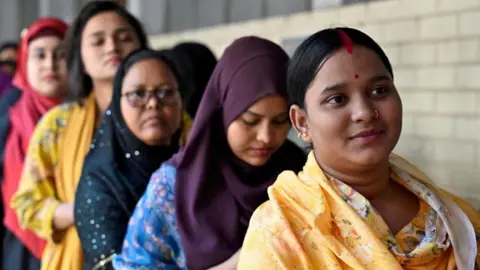
Although the ban on her Awami League raises concerns about the election's fairness, voters expressed a refreshing sense of agency. Over 120 million people are eligible to vote, and around 40% of them are under 37. They also participated in a referendum on constitutional changes proposed by the interim government, aimed at reforming a deeply flawed political system. Interim leader Muhammad Yunus, a Nobel laureate, declared a new beginning for Bangladesh after voting.
Turnout reached 49% by 14:00 local time, with nearly a million police and soldiers deployed to maintain order. The two main contenders in the election, Tarique Rahman (BNP) and Shafiqur Rahman (Jamaat), both cast their ballots amidst high public interest. Rahman, who criticized Jamaat's religious rhetoric, promised an agenda focused on economic progress and national reconciliation.
With the significant absence of the Awami League, both BNP and Jamaat-e-Islami are vying for power, though the latter has raised alarms about underrepresentation of women among candidates, despite women's prominent roles in the protests that sparked these elections. As Bangladesh moves forward, all eyes are on the outcome, marking a pivotal moment in its quest for authentic democratic governance.
The election pits the centre-right Bangladesh Nationalist Party (BNP) against a coalition led by the Islamist Jamaat-e-Islami, which joined forces with a party born from the student uprising. Results are expected on Friday, and there’s widespread hope among voters of a return to democracy.
For the first time since 2008, the outcome of an election in Bangladesh cannot be predicted with certainty. Previous elections were condemned as systematically rigged in favour of Sheikh Hasina. She has been sentenced to death in absentia for the violent crackdown against protesters, leading her to seek refuge in India, where she continues to dismiss the election’s legitimacy.
Although the ban on her Awami League raises concerns about the election's fairness, voters expressed a refreshing sense of agency. Over 120 million people are eligible to vote, and around 40% of them are under 37. They also participated in a referendum on constitutional changes proposed by the interim government, aimed at reforming a deeply flawed political system. Interim leader Muhammad Yunus, a Nobel laureate, declared a new beginning for Bangladesh after voting.
Turnout reached 49% by 14:00 local time, with nearly a million police and soldiers deployed to maintain order. The two main contenders in the election, Tarique Rahman (BNP) and Shafiqur Rahman (Jamaat), both cast their ballots amidst high public interest. Rahman, who criticized Jamaat's religious rhetoric, promised an agenda focused on economic progress and national reconciliation.
With the significant absence of the Awami League, both BNP and Jamaat-e-Islami are vying for power, though the latter has raised alarms about underrepresentation of women among candidates, despite women's prominent roles in the protests that sparked these elections. As Bangladesh moves forward, all eyes are on the outcome, marking a pivotal moment in its quest for authentic democratic governance.