In brief
Despite the war in Ukraine, the number of billionaires in Russia has surged to unprecedented levels, with their political influence substantially reduced under President Putin. This article explores how Putin's regime has kept the ultra-rich on his side through strategic control and economic incentives, while dissenters face dire consequences.
During the war with Ukraine, the number of billionaires in Russia has reached an all-time high. But in the 25 years Vladimir Putin has been in power, Russia's rich and powerful - known as oligarchs - have lost almost all their political influence.
All this is good news for the Russian president. Western sanctions have failed to turn the uber-rich into his opponents, and his carrot-and-stick policies have turned them into silent backers.
Former banking billionaire Oleg Tinkov knows exactly how the sticks work. The day after he criticized the war as crazy in an Instagram post, his executives were contacted by the Kremlin. They were told his Tinkoff Bank, Russia's second-largest at the time, would be nationalized unless all ties to its founder were cut.
I couldn't discuss the price, Tinkov told the New York Times. It was like a hostage - you take what you are offered. I couldn't negotiate. Within a week, a company linked to Vladimir Potanin - currently Russia's fifth-richest businessman, who supplies nickel for fighter jet engines - announced it was buying the bank. It was sold for only 3% of its true value, Tinkov claims.
Ultimately, Tinkov lost almost $9bn (£6.5bn) of his fortune and left Russia.
This stark situation is a far cry from the initial power dynamics seen in post-Soviet Russia, when oligarchs burgeoned with wealth and influence amidst political turmoil.
Boris Berezovsky, one of the most powerful oligarchs of that time, claimed to have orchestrated Putin's rise to power in 2000. He later lamented that he misjudged Putin's tyrannical nature, which extinguished his own influence and led to his exile.
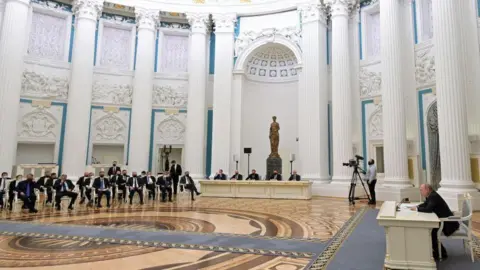
On 24 February 2022, the day Putin ordered a full-scale invasion of Ukraine, he summoned Russia's richest to the Kremlin. Their fortunes were about to take a massive hit, yet they remained muted.
Forbes noted that the number of billionaires dropped from 117 to 83 by April 2022, largely due to the war and sanctions, and they collectively lost $263bn in wealth. However, as the years rolled on, many billionaires found opportunities to benefit from the war economy, contributing to Russian economic growth in 2023 and 2024.
As of 2024, Russia boasted its highest-ever number of billionaires at 140, with a total wealth of $580bn, just shy of the pre-invasion high. Interestingly, those who aligned themselves closely with the Kremlin continued to thrive economically.
In contrast, oligarchs like Mikhail Khodorkovsky faced severe repercussions for defiance, illustrating the stark reality of dissent under Putin's regime.
This examination reveals how, despite the challenging conditions imposed by external pressures, Putin has managed to maintain a firm grip on Russia's elite, using a mix of economic incentives and strategic suppression of dissent.