In brief
As Europe gears up for the Munich Security Conference, the legacy of Trump's administration casts a long shadow. From the controversial speech by Vice President JD Vance a year ago to ongoing tensions regarding defense responsibilities and trade, the transatlantic alliance is facing critical challenges. The conference, which sees participation from over 50 world leaders, aims to address these pervasive issues amid a backdrop of geopolitical uncertainty, especially with the ongoing conflicts involving Russia and the security challenges for Europe.
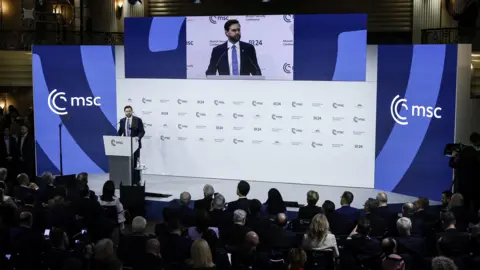
This week marks the one-year anniversary of US Vice President JD Vance's bombshell speech at the Munich Security Conference, where he strongly criticized Europe's policies on migration and free speech. His assertion that the greatest threat to the continent comes from within visibly stunned the audience, signifying a drastic shift in transatlantic dynamics since the Trump administration rose to power.
The upcoming conference will see US Secretary of State Marco Rubio leading the US delegation as more than 50 world leaders convene to deliberate on pressing global security issues. The discussions come against a backdrop of increasing instability in Europe, exacerbated by the US's recent strategic reassessments regarding its role in European defense.
The National Security Strategy published late last year led by the Trump administration emphasized that Europe must take 'primary responsibility for its own defense', stirring fears about the reliability of US support. This conference arrives at a time when the previously taken-for-granted US commitment to NATO and its allies is being intensely scrutinized.
The geopolitical climate has fundamentally shifted, marked by tensions over Greenland and the ongoing threats from Russia. As Trump makes demands for territorial claims like Greenland, questions loom over whether the transatlantic alliance is becoming irreparably fractured. The Munich Security Conference aims to clarify these issues, offering a platform for dialogue amidst skepticism about future cooperation.
While officials insist that the principle of NATO's Article 5—an attack on one is an attack on all—remains intact, the unpredictability of the Trump administration poses challenges. Diplomatically, the US's approach has led to friction with European partners, particularly concerning trade, migration, and collective security strategies.
Former MI6 chief Sir Alex Younger acknowledged that while the alliance has been strained by Trump's rhetoric and policies, it is not entirely broken. He argues for a more equitable distribution of defense responsibilities, calling for Europe to step up amid rising tensions with adversaries like Russia.
The Munich Security Conference will not only spotlight these critical issues but also seek solutions to restore trust and unity among allies facing a precarious global landscape.