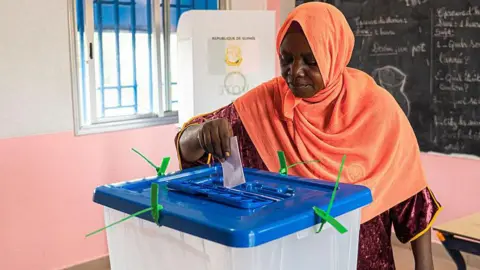
On Sunday, citizens of Guinea and the Central African Republic (CAR) will go to the polls to elect their presidents for terms of office of seven years.
Both contests could, in theory, go on to run-off ballots. Yet in both, the incumbents are strong favourites, with observers predicting they will clinch victory outright in the first round with more than 50% of the vote.
But that's where the similarities end.
The CAR, vast and landlocked, is one of Africa's poorest countries, marred by chronic instability for decades, with a succession of armed groups motivated by a variety of local grievances, opportunities for racketeering or political ambitions.
From 2013 to 2016 it was only the intervention of African, French and then UN peacekeepers that averted a slide into deeper inter-communal violence.
The national government in Bangui, the riverside capital on the southern border, just across the water from the Democratic Republic of Congo, has often struggled to assert its authority in the distant outer-lying regions of the north or far east.
Despite these enduring fragilities, multi-party politics has mostly survived, with a fair degree of tolerance for opposition and protest.
There is a sense of national identity and this year has seen two of the most significant rebel groups drawn back into the peace process and starting to disarm and demobilise.
The country has a pioneering special court for trying human-rights crimes, staffed with a blend of national and international judges.
President Faustin-Archange Touadéra, a mathematician and former university vice-chancellor, is seen as a more political figure today than when he first assumed office as a post-conflict consensus leader.
In contrast, in Guinea, Gen Mamadi Doumbouya, who led the September 2021 coup to oust the previous president, is preparing to transition into a constitutionally elected position.
Despite the political constraints, his efforts have been met with cautious optimism from international observers and west African regional leaders, signaling a potential return to stability in both nations.