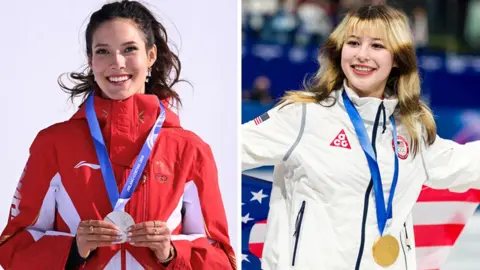
An unusual battle is unfolding over the Winter Olympics in Milan - not on the slopes or in the rinks, but on the internet. At its heart are Eileen Gu, a freestyle skier, and Alysa Liu, a figure skater. They have a lot in common: both are young women of American-Chinese heritage who were born and raised in the US. And they are champions in their field.
And yet, one is being hailed a trailblazer, while the other is deemed a traitor. At least that's the case in the eyes of some in the US. On Chinese social media, it's the other way around. Why? Liu, the daughter of a political activist who fled China after a deadly crackdown, is competing under the US flag. And Gu, whose mother moved to the US for higher education, spent her childhood summers visiting Beijing. She is representing China in Milan.
That seems to rankle with some Americans. Eileen Gu competes for China and gets paid millions to do it. Alysa Liu is the daughter of a Chinese immigrant who participated in the Tiananmen Square protests. In a world of Eileen Gus, be an Alysa Liu, said one post on X.
Much of this backlash appears to be driven by political commentators and a vocal minority on X, rather than the broader public or the sporting world. The underlying current is the competition between the US and China - the world's two biggest economies are constantly vying for an edge in everything, from trade to tech.
The 'snow princess' and the 'patriot': Known in China by her nickname Snow Princess, Eileen Gu was born in California to a Chinese mother and American father. Gu grew up with a foot firmly in both worlds, spending her summers in Beijing and attending private school in San Francisco.
She switched from competing for the US to Team China in 2019, ultimately stirring a complex national debate regarding identity and loyalty. Meanwhile, Alysa Liu, whose father fled China after being involved in protests, stands as a symbol of American patriotism amidst a climate of geopolitical tension.
The contrasting reactions to their athletic commitments illustrate a greater societal divide about national loyalty and cultural identity, illuminating how the sports arena can become a microcosm for global tensions.