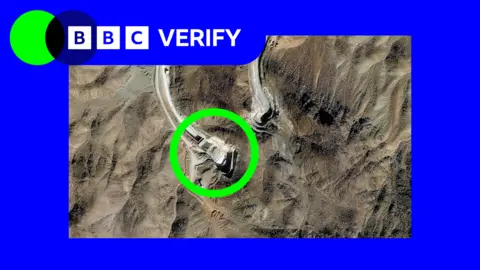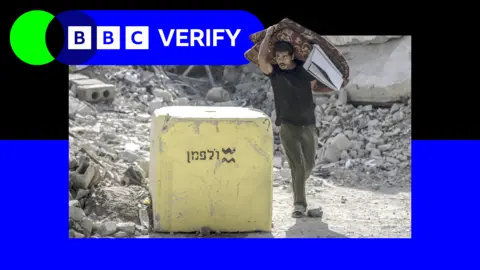
Israel has moved the blocks which are meant to mark its post-ceasefire line of control deeper into Gaza in several places, leading to confusion among Palestinians. Satellite images reviewed by BBC Verify indicate that Israel has repositioned blocks in at least three areas.
This shift comes following a US-brokered deal with Hamas, under which Israel agreed to withdraw troops beyond a line marked in yellow on military maps. This line has been visually represented on the ground with concrete yellow blocks. Recently, Defense Minister Israel Katz warned that anyone crossing the Yellow Line would be 'met with fire.'
Since these comments were made, there have been multiple deadly incidents near the line. In Beit Lahia, Jabalia, and al-Tuffah, the Israel Defense Forces (IDF) placed blocks and then moved them further inside Gaza, resulting in significant changes to control markers.
In al-Tuffah, satellite images capture IDF troops moving at least seven blocks between November 27 and December 25, positioning them an average of 295m deeper into the Strip.
BBC Verify's analysis shows that beyond these previously mentioned markers, over half of 205 other markers have been placed significantly deeper inside Gaza than what was initially denoted on maps. An IDF spokesperson dismissed claims that the Yellow Line has been adjusted, asserting they are marking the line based on real-time operational assessments.
Analysis of satellite images suggests some sections of the Yellow Line remain unmarked on the ground—leading civilians to struggle understanding what areas are considered 'dangerous combat zones.'
A local man near Khan Younis reported being 'trapped' after the blocks shifted. He expressed fear for his and other residents' safety amidst escalating military operations and gunfire from across the newly moved lines.
The recent adjustments raise concerns about territorial control strategies in Gaza, with experts suggesting that this method allows Israel to expand control informally without officially altering borders. The IDF's movements also include demolishing nearby structures and creating fortifications that complicate civilian life.
Amid these shifts, a series of deadly incidents have occurred near the Yellow Line, including an IDF strike that killed several civilians during a wedding. Eyewitness accounts describe harrowing scenes while families are caught in the crossfire of shifting military strategies.
The situation continues to deteriorate as the international community weighs in on the complexities surrounding the ongoing conflict, highlighting the urgent need for a comprehensive resolution.