In brief
Recent revelations from the Nursey album, filled with photographic evidence, illuminate the fierce participation and leadership of women during India's civil disobedience movement, showcasing how they reshaped political landscapes and challenged gender dynamics. From arresting images of women confronting police to joyous acts of defiance, these historical snapshots give a voice to the often-ignored heroines of India's struggle for freedom.
A set of recently uncovered photographs sheds light on the pivotal role women played in the civil disobedience movement in India, led by Mahatma Gandhi during the years 1930-31. These images serve as potent reminders that women not only participated in this massive anti-colonial effort but often took the lead, showcasing their strength in advocating for political change.
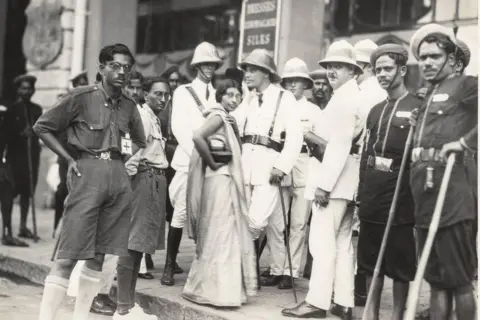
The photographs, originating from a forgotten album recently acquired by the Alkazi Foundation, reveal a dynamic scene where women emerged from the periphery to take center stage in India’s struggle for independence. Historical narratives have traditionally sidelined female contributions, but these images depict their defiance against colonial authority, exemplified by instances such as Lilavati Munshi boldly confronting British police outside a boycotted store.
Gandhi's famous salt march in 1930 marked the beginning of widespread civil disobedience, with women quickly becoming pivotal figures instead of mere supporters. The collection captures striking moments of women's resistance and leadership, challenging established gender roles, as they organized boycotts and rallied crowds.
The Nursey album is not merely a series of photographs; it captures the essence of a transformative era in which women's activism reshaped the political landscape, promoting empowerment amid societal constraints. As thousands of female volunteers joined the movement, they violated traditional norms and fostered a new field of civic engagement.
This visual documentary reaches beyond the lives of individuals like Munshi, showcasing a multitude of women and children actively participating in salt production and leading boycott processions, thereby engraining the ideals of non-violence and civil disobedience into their communities.
In recognizing these women, scholars highlight not only their historical significance but also the reversal of power dynamics during a time when established male-dominated narratives prevailed. Their determination continues to resonate as a testament to the essential, transformative role women played within India's fight for independence.
With the release of a new book and museum exhibits featuring these photographs, the stories of these women who once stood on the front lines of agitation during India's freedom struggle are finally receiving the acknowledgment they have long been denied.