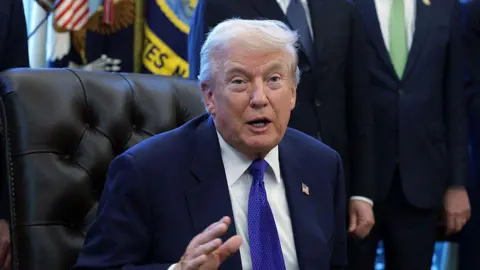
WASHINGTON (AP) — The Trump administration is expected to revoke a long-standing scientific finding that forms the basis for regulating greenhouse gas emissions in the U.S., as reported by a White House official earlier this week. The Environmental Protection Agency (EPA) will finalize a rule rescinding the 2009 endangerment finding, an Obama-era declaration that stated carbon dioxide and other greenhouse gases pose a risk to public health. According to White House press secretary Karoline Leavitt, President Trump is set to announce what she described as the most significant deregulatory actions in history aimed at enhancing American energy dominance.
Originally enacted under the Clean Air Act, the endangerment finding allowed for various climate regulations, including standards on auto emissions designed to protect against worsening climate change effects such as deadly floods and catastrophic wildfires. Legal experts suggest that significant legal challenges will likely arise against any ruling that attempts to roll back these regulations, labeling the move as one of the most substantial threats to climate policies in U.S. history.
As various stakeholders monitor the situation, an EPA spokesperson confirmed the agency is working on a new rule regarding the endangerment finding, but further details remain uncertain. Critics, including environmental advocates, argue that scrapping the endangerment finding would increase climate pollution, healthcare costs, and lead to premature deaths, raising concerns about a potential backlash against such regulatory rollbacks.
Many environmental groups stress that the scientific consensus overwhelmingly supports the dangers posed by climate change, with one notable case, Massachusetts v. EPA, upholding that greenhouse gases are indeed pollutants under the Clean Air Act. They warn that the administration's dilution of climate measures contradicts mounting scientific evidence and places public health at increased risk. The broader implications of such regulatory changes may have lasting effects on both the environment and public health agendas in the United States.
Originally enacted under the Clean Air Act, the endangerment finding allowed for various climate regulations, including standards on auto emissions designed to protect against worsening climate change effects such as deadly floods and catastrophic wildfires. Legal experts suggest that significant legal challenges will likely arise against any ruling that attempts to roll back these regulations, labeling the move as one of the most substantial threats to climate policies in U.S. history.
As various stakeholders monitor the situation, an EPA spokesperson confirmed the agency is working on a new rule regarding the endangerment finding, but further details remain uncertain. Critics, including environmental advocates, argue that scrapping the endangerment finding would increase climate pollution, healthcare costs, and lead to premature deaths, raising concerns about a potential backlash against such regulatory rollbacks.
Many environmental groups stress that the scientific consensus overwhelmingly supports the dangers posed by climate change, with one notable case, Massachusetts v. EPA, upholding that greenhouse gases are indeed pollutants under the Clean Air Act. They warn that the administration's dilution of climate measures contradicts mounting scientific evidence and places public health at increased risk. The broader implications of such regulatory changes may have lasting effects on both the environment and public health agendas in the United States.