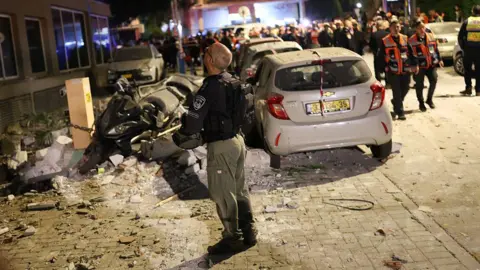
It was late at night when an Iranian cluster bomb flew through the ceiling of an elderly couple's apartment in central Israel and exploded in their tiny living room, killing them both. The path of the bomb was still clearly mapped onto the ash-covered debris left behind. A large hole in the ceiling of their top-floor apartment marked where it punched through, forcing broken concrete and metal rods inwards.
Shrapnel holes across the back walls showed the force of the explosion, which destroyed the front of the apartment - leaving it open to the street outside. Inside, a walking frame lay upended on the floor under the ash-covered furniture and rubble.
We heard three noisy interceptions, but on the fourth one, we knew it was our house, said Sigal Amir, who lives next door and was sheltering in her safe room when the explosion hit. There was a massive boom and I felt a pain in my ear from the blast. The neighbours live five metres from us – their door was blown off and their house was full of dust like snow. She said the couple had not been in the shelter when the bomb hit as one of them had mobility issues.
Deaths from Iran's daily missile attacks have been rare in Israel, with air defences intercepting most of them. But cluster bombs disperse over a wide area and are much harder to defend against, even when the missile carrying them is shot down. Israeli military spokesman Lt Col Nadav Shoshani stated that while missiles carrying cluster bombs were intercepted, the bombs themselves are very difficult to stop due to their wide dispersal.
As the war continues, Israel faces the reality that the number of casualties may increase if cluster munitions remain in use. Coupled with the psychological toll on the civilian population who regularly endure sirens alerting them to incoming missiles, the situation is dire. Sigal, reflecting on the recent explosions and the ongoing threat says, To be honest, in the last days I'm losing hope a little bit. I feel there's no end to it, there's no direction; we can't see the light at the end of the tunnel.
The ongoing war, described by Israeli Prime Minister Netanyahu as a decisive moment in their regional battle, highlights the complexities and emotional burdens faced by those living in the conflict zone.
Shrapnel holes across the back walls showed the force of the explosion, which destroyed the front of the apartment - leaving it open to the street outside. Inside, a walking frame lay upended on the floor under the ash-covered furniture and rubble.
We heard three noisy interceptions, but on the fourth one, we knew it was our house, said Sigal Amir, who lives next door and was sheltering in her safe room when the explosion hit. There was a massive boom and I felt a pain in my ear from the blast. The neighbours live five metres from us – their door was blown off and their house was full of dust like snow. She said the couple had not been in the shelter when the bomb hit as one of them had mobility issues.
Deaths from Iran's daily missile attacks have been rare in Israel, with air defences intercepting most of them. But cluster bombs disperse over a wide area and are much harder to defend against, even when the missile carrying them is shot down. Israeli military spokesman Lt Col Nadav Shoshani stated that while missiles carrying cluster bombs were intercepted, the bombs themselves are very difficult to stop due to their wide dispersal.
As the war continues, Israel faces the reality that the number of casualties may increase if cluster munitions remain in use. Coupled with the psychological toll on the civilian population who regularly endure sirens alerting them to incoming missiles, the situation is dire. Sigal, reflecting on the recent explosions and the ongoing threat says, To be honest, in the last days I'm losing hope a little bit. I feel there's no end to it, there's no direction; we can't see the light at the end of the tunnel.
The ongoing war, described by Israeli Prime Minister Netanyahu as a decisive moment in their regional battle, highlights the complexities and emotional burdens faced by those living in the conflict zone.