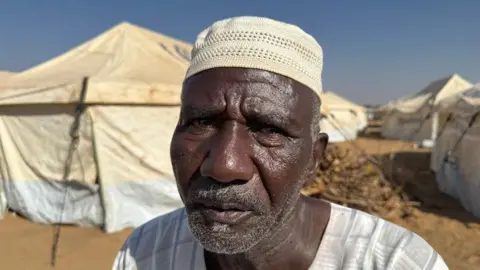
Abdulqadir Abdullah Ali suffered serious nerve damage to his leg during the long siege of the Sudanese city of el-Fasher because he could not get medicine for his diabetes.
The 62-year-old walks with a heavy limp, but he was so panicked when fighters from the paramilitary Rapid Support Forces (RSF) finally captured the city in the western Darfur region, he felt no pain as he ran.
The morning the RSF came there were bullets, many bullets, and explosives going off, he says.
People were out of control [with fear], they ran out of their houses, and everyone ran in different directions, the father, the son, the daughter - running.
The fall of el-Fasher after an 18-month siege is a particularly brutal chapter in Sudan's civil war. The BBC has travelled to a tent camp in northern Sudan set up in army-controlled territory to hear first-hand the stories of those who escaped. The team was monitored by the authorities throughout the visit.
The RSF has been fighting the regular army since April 2023 when a power struggle between them erupted into war. Taking over el-Fasher was a major victory for the paramilitary group, pushing the army out of its last foothold in Darfur.
But evidence of mass atrocities has drawn international condemnation and focused greater American attention on trying to end the conflict.
Warning: This report contains details that some readers may find distressing.
We found Mr Ali wandering around the camp, located in the desert about 770km (480 miles) north-east of el-Fasher, near the town of al-Dabbah. He was trying to register his family for a tent.
They [RSF fighters] were shooting at the people - the elderly, the civilians, with live ammunition, they would empty their guns on them, he told us.
Some of the RSF came with their cars. If they saw someone was still breathing, they drove over them.
Mr Ali said he ran when he could, crawling along the ground or hiding when the threat got too close. He managed to get to the village of Gurni, a few kilometres from el-Fasher.
The road here was full of death, he said.
They shot some people directly in front of us and then carried them and threw them far away. And on the road, we saw dead bodies out in the open, unburied. Some had lain there for two or three days.
Some of those who did not take the long trek to al-Dabbah made it to a humanitarian hub in Tawila, some 70km from el-Fasher. Others crossed into Chad. But the UN says less than half of the 260,000 people estimated to have been in the city before it fell have not been accounted for.
Aid agencies believe many people did not get very far - unable to escape because of danger, or detention, or the cost of buying their way out.
Mr Adam said the fighters also raped women, corroborating widespread accounts of sexual violence.
There are mostly women in the camp, and many do not want to be identified to protect those left behind.
Many have arrived at the camp empty handed - having to pay with what money they had to get through checkpoints.
The RSF, led by Mohamed Hamdan Dagalo, had been allies of the army until the two fell out, but it remains to be seen how this complex situation will unfold for the victims and survivors alike.
As the humanitarian crisis deepens, the resilience of the survivors echoes amidst the ongoing chaos.