In brief
In a strategic move, the US has decided to purchase a fleet of icebreakers from Finland, the global leader in icebreaker technology. This decision, driven by national security concerns regarding Arctic dynamics impacted by climate change, marks a significant step in enhancing the US Coast Guard's operational capabilities. Finland, with its extensive experience in icebreaker design and construction, is supplying four vessels while seven will be produced domestically using Finnish designs. This shift highlights the growing geopolitical interest in the Arctic as new trade routes and resources become more accessible.
As President Donald Trump continues to insist that the US needs to own Greenland, his wider focus on the Arctic region has seen Washington order new icebreakers.
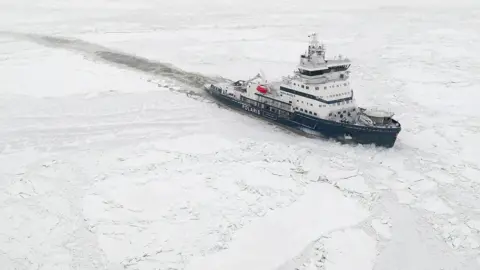
For these ships, which can sail through seas covered in solid ice, the US has gone to the world expert – Finland.
Temperatures are sub-zero inside Aker Arctic Technology's ice laboratory, as the scale model of an icebreaker cruises down a 70m-long simulation tank.
It ploughs a neat channel through the frozen surface of the water.
Undergoing testing at a facility in Helsinki, Finland's capital, this is a design for the next generation of the country's icebreakers.
It's crucial that it has sufficient structural strength and engine power, says ice performance engineer, Riikka Matala.
Mika Hovilainen, the firm's chief executive, adds that the shape of the vessel is also crucial. You have to have a hull form that breaks ice by bending it downwards, he says. It's not cutting, it's not slicing.
Finland is the undisputed world leader when it comes to icebreakers. Finnish companies have designed 80% of all those currently in operation, and 60% were built at shipyards in Finland.
The country leads the way out of necessity, explains Maunu Visuri, president and chief executive of Finnish state-owned company Artica, which operates a fleet of eight icebreakers.
Finland is the only country in the world where all the harbours may freeze during wintertime, he says, adding that 97% of all goods to the country are imported by sea.
During the coldest months, icebreakers keep Finland's ports open, and work as pathfinders for big cargo ships. It's really a necessity for Finland. We say that Finland is an island.
It was this expertise that saw Trump announce in October that the US planned to order four icebreakers from Finland for the US Coast Guard.
A further seven of the vessels, which the US is calling Arctic Security Cutters, are to be built in the US, using Finnish designs and expertise.
We're buying the finest icebreakers in the world, and Finland is known for making them, said Trump.
Under US law, the country's naval and coastguard ships must be domestically-built, but in this case the president waived that requirement on national security grounds. He cited aggressive military posturing, and economic encroachment by foreign adversaries, by which he means Russia and China.
This US concern comes as climate change continues to make the Arctic Ocean more navigable for cargo ships, at least if icebreakers lead the way by cutting a path.
There's simply a lot more traffic in that part of the world now, notes Peter Rybski, a retired US Navy officer and Helsinki-based Arctic expert.
The Finns can build these complex vessels remarkably swiftly - it takes between two-and-a-half and three years - thanks to a streamlined production method, and decades of experience. Over 100 years, we have practised this, says Artica's Visuri. You've got this cycle of designers, operators, builders. That's why Finland is the superpower of icebreakers.