In brief
In a recent press conference, Canadian Prime Minister Mark Carney confirmed that he stands behind his remarks made at Davos calling out superpowers. This follows claims by US Treasury Secretary Scott Bessent, who stated that Carney aggressively walked back his comments in a call with President Trump. Carney denied this assertion, highlighting a productive conversation with Trump about trade and international relations.
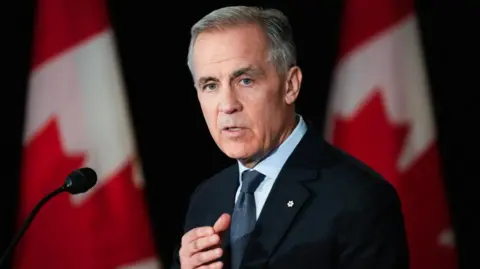
Canadian Prime Minister Mark Carney has told reporters he stands behind his speech in Davos calling out unconstrained superpowers, after a Trump official said he had aggressively walked it back in a call with US President Donald Trump.
To be absolutely clear, and I said this to the president, I meant what I said in Davos, Carney said on Tuesday, confirming he and Trump had spoken by phone.
US Treasury Secretary Scott Bessent had told Fox News on Monday that Carney was very aggressively walking back some of the remarks to Trump.
Carney made global headlines for his Davos speech, in which he indirectly called out the US president for a rupture in the postwar world order.
Trump responded in his own Davos speech the following day by saying that Canada lives because of the United States.
Speaking to reporters in Ottawa on Tuesday, Carney denied Bessent's recollection of the phone call.
He added that it was the US president who had called him on Monday, and that they had a very good conversation on a wide range of subjects, including Ukraine, Venezuela, Arctic security and Canada’s recent trade agreement with China.
Carney said the two also discussed the USMCA, a free-trade pact between Canada, the US and Mexico that is up for a mandatory review later this year.
Carney noted that his speech in Davos clearly outlined how Canada was the first country to understand the change in US trade policy that (Trump) had initiated, and we're responding to that.
He added that the president understood Canada's position.
In the Fox News interview on Monday, Bessent criticized Canada's decision to negotiate a trade deal with China, adding that he was not sure what the Prime Minister was thinking when he made his speech in Davos.
Canada depends on the US, Bessent said. There's much more north-south trade than there could ever be east-west trade.
His remarks came after Trump threatened Canada with 100% tariffs on its goods if it allows Chinese goods to flow freely to the US, skirting levies.
The deal between Ottawa and Beijing would lower levies on Canadian canola oil from 85% to 15% by March, while Canada will tax a limited number of Chinese electric vehicles (EVs) at the most-favored-nation rate, 6.1% – down from 100%.
Carney emphasized that Canada is not pursuing a free-trade deal with China and has never considered it.
Speaking to reporters on Monday, Carney remarked that he believed Trump's latest tariff threat is a negotiation tactic ahead of talks on USMCA.
The president is a strong negotiator, and I think some of these comments and positioning should be viewed in the broader context of that, he said.