In brief
The crash, involving driver Jing Sheng Dong of E&P Travel, raises concerns over driver fatigue, repeated speeding violations, and the lack of collision‑avoidance technology on commercial buses. NTSB recommendations for driver monitoring and rest‑period enforcement have long gone unadopted, while industry costs keep newer safety features out of reach for many fleets. Federal authorities are probing the crash’s background and company practices amid calls for stronger commercial vehicle safety standards.
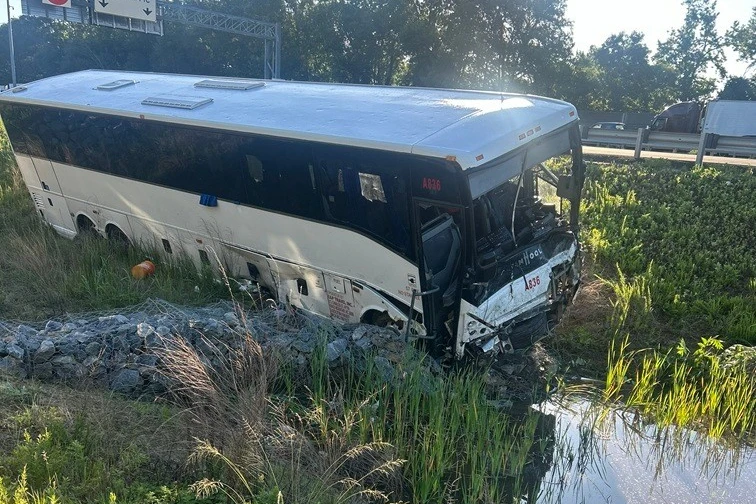
A commercial bus crash in Virginia that killed five people and injured dozens of others has raised serious questions about the driver, the company that employed him, and the overall safety of the industry.
The incident, which occurred on Friday morning, is still under investigation by the National Transportation Safety Board (NTSB). Even the early findings highlight the hazards whenever a bus or semi‑truck goes into other vehicles – a scenario that is statistically far safer for bus passengers than car occupants but still carries significant risk.
While many new cars now include collision‑avoidance technologies and emergency braking systems, commercial buses largely lack these features. This deficiency persists despite long‑standing NTSB recommendations and proposed regulations that would require such equipment.
Observers point to the crash’s timing as an indicator of potential driver fatigue. Court records show that the bus driver, Jing Sheng Dong of New York City, now faces manslaughter charges and a reckless‑driving count, after previously receiving two speeding tickets in the same three‑year period.
Under federal rules, a driver convicted twice within three years for driving more than 15 mph over the limit must be disqualified for 60 days. Dong’s first ticket was for 73 mph in a 55‑mph zone, and his second was for running 72 mph in a 50‑mph zone. The 48‑year‑old now carries five involuntary‑manslaughter charges and one reckless‑driving charge.
Damian Einstein, an expert witness in transportation lawsuits, doubts that criminal charges alone will enhance road safety. He argues that the real responsibility lies with the company that sets schedules and hires drivers, not the individual driver.
The crash occurred around 2:30 a.m., roughly five hours into a trip from New York to North Carolina. Federal law limits bus drivers to 10 hours of driving or 15 hours of work without at least eight hours of rest in between. Although electronic logs help enforce these limits, the sport of tampering with paper logs still exists.
Earlier this year, another E&P Travel driver was involved in a similar crash in North Carolina that injured nine people. The driver, Pei Jie Lu, later pleaded guilty to failure to reduce speed. The incident followed three months after Lu was ticketed in Maryland for negligent driving – a pattern that repeats itself among this company’s fleet.
Transportation Secretary Sean Duffy has ordered federal investigators to examine Dong’s background, the company’s hiring and training practices, and the school that trained him. The Federal Motor Carrier Safety Administration has also verified that New York followed its own rules when issuing Dong’s commercial driver’s license, but the focus so far has been on truck drivers rather than buses.
A History of Speeding
Repeated speeding violations, such as those found in Dong’s record, set the stage for potential liability. The driver’s experience illustrates how federal guidelines are translated into real‑world enforcement – or the lack thereof.
A Long List of Unfulfilled Recommendations
Even when the National Highway Traffic Safety Administration (NHTSA) endorses a new safety feature, it often takes years to finalize a rule that applies to commercial vehicles. For example, seat‑belt mandates weren’t required on commercial buses until 2016, and collision‑avoidance technology provisions remain pending.
Many NTSB recommendations – from stricter driver‑fatigue standards to collision‑avoidance mandates – have stalled because regulators judge the costs too high. Since the NTSB’s mandate is purely advisory, it cannot enforce its recommendations, leaving the responsibility on Congress, regulators, and industry leaders.
Many Bus Companies Do Invest in Safety
The American Bus Association works to promote safety measures. Its president, Fred Ferguson, points to driver‑monitoring systems that use inward‑facing cameras and telematics. Some companies even deploy collision‑avoidance equipment on newer models, arguing that safety reduces catastrophic accidents and protects the company’s financial health.
However, cost remains a barrier. Newly built motorcoaches can cost around $650,000, and recent tariff increases have added another 10 % burden. Managers report that while newer buses come with the most advanced safety features, the rising expense slows upgrades across fleets.
“Operating safely is not just a moral or ethical obligation; it’s good business,” said Ferguson, who represents about 40 % of the 1,800 companies that operate roughly 50,000 motorcoaches in the United States and Canada.
___
Ramer reported from Concord, New Hampshire. Associated Press writer Allen G. Breed contributed from Wake Forest, North Carolina.
}