The oil tanker seized by US forces on Wednesday had a track record of faking or concealing its location information, apparently to hide its activities, ship tracking data shows.
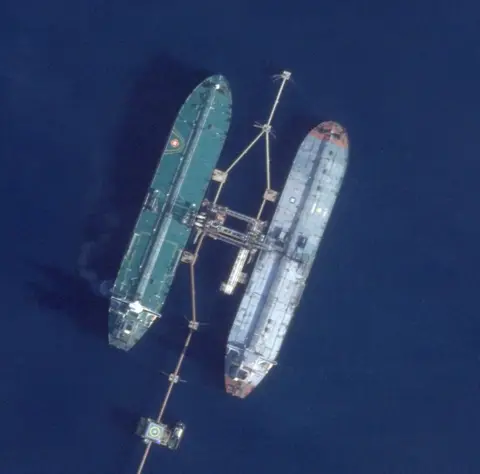
On Wednesday evening, the US confirmed that its forces seized a vessel during a helicopter-launched raid near the coast of Venezuela. BBC Verify identified the ship as the Skipper by comparing visuals released by the US with a reference image from TankerTrackers.com, a site monitoring oil shipments.
Before its seizure, the ship hadn't declared its position since November 7, raising suspicions about its movements. Maritime analytics firm Kpler suggested that Skipper engaged in ship-to-ship transfers to obscure its activities.
US Attorney General Pam Bondi described the vessel as a crude oil tanker used to transport sanctioned oil from Venezuela and Iran. The ship was first sanctioned in 2022 under the name Adisa for alleged involvement in an international oil smuggling network.
Although sailing under the Guyanese flag, the Guyanese government stated that the Skipper was falsely registered, indicating it was not legally recognized under their jurisdiction.
Experts indicated that this ship is likely part of the "dark fleet," a network of vessels that evade oil sanctions by disguising ownership and manipulating tracking information.
Hiding its position
Under a UN treaty, all ships above a certain tonnage must have an Automatic Identification System (AIS) to broadcast their location information. However, the Skipper’s tracking history shows discrepancies. Its last known port call was falsely recorded at Soroosh in Iran on July 9, following stops in Iraq and the UAE, according to MarineTraffic.
Kpler asserted that the ship had loaded oil from these regions while using spoofing to disguise its actual position. This is a common tactic among vessels involved in circumventing sanctions.
The US sanctions placed on Venezuelan oil exports in 2019 have made it increasingly regular for ships to conceal their locations while loading oil. Analysts noted that the Skipper had broadcast misleading AIS signals while shifting between points in Venezuela and Iran, even as it prepared for a journey toward China with illegally obtained crude.
A satellite image confirmed it's presence at the Port of Jose in Venezuela on November 18, long after it ceased showing on tracking platforms.
Recent Developments
Kpler analysts revealed that by November 16, Skipper had loaded at least 1.1 million barrels of Merey crude, listing Cuba as its intended destination. Notably, on December 7, satellite data indicated a ship-to-ship transfer occurred off the coast of Venezuela, setting the stage for Skipper's subsequent capture.
Experts in maritime security expressed that while ship-to-ship transfers aren’t inherently illegal, their prevalence among vessels evading sanctions is alarming. Discussions surrounding the dubious ownership of Skipper reveal ties to a deeper web of maritime logistics used to facilitate unsanctioned oil trade.
MarineTraffic lists Nigeria-based Thomarose Global Ventures Ltd as the beneficial owner and Marshall Islands-based Triton Navigation Corp as the registered owner. Triton has been implicated in smuggling networks run by sanctioned individuals.
BBC Verify is actively seeking comment from both companies regarding their connections to the Skipper and its operations.