In brief
Venezuelan leader Maduro accuses the U.S. of seeking his country's oil reserves amid rising tensions marked by recent military actions against Venezuelan vessels. The article explores Venezuela's oil production status, discusses U.S. interests, and assesses whether oil is at the heart of U.S. strategies toward Venezuela.
Venezuelan leader Nicolás Maduro says escalating pressure from the US comes down to one thing: Washington wants to grab the South American nation's vast oil reserves.
This week the American military seized an oil tanker, which was allegedly carrying Venezuelan oil being shipped in violation of US sanctions, and threatened action against other ships.
The move followed a series of military strikes on Venezuelan boats, which the US alleges are drug-trafficking vessels. President Trump has called on Maduro to leave office, accusing him of sending narcotics and murderers to the US.
So is it Venezuela's oil that Trump really wants? And would it actually be worth it?
How much oil does Venezuela have?
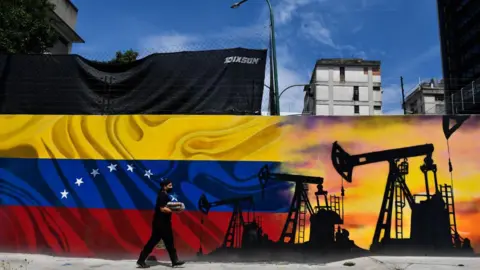
It is true that with an estimated 303 billion barrels, Venezuela is home to the world's largest proven oil reserves.
But the amount of oil the country actually produces today is tiny by comparison.
Output has dropped off sharply since the early 2000s, as former President Hugo Chavez and then the Maduro administration tightened control over the state-run oil company, PDVSA, leading to an exodus of more experienced staff.
Though some Western oil firms, including the US company Chevron, are still active in the country, their operations have shrunk significantly as the US has widened sanctions and targeted oil exports, aiming to curb Maduro's access to a key economic lifeline.
Sanctions - which the US first put in place in 2015 during President Obama’s administration over alleged human rights violations - have also left the country largely cut off from the investment and the parts it needs.
In November, Venezuela produced an estimated 860,000 barrels per day, according to the latest oil market report from the International Energy Agency. That is barely a third of what it was 10 years ago and accounts for less than 1% of world oil consumption.
Does Trump want Venezuela's oil?
Some in the US have made the case for intervention in Venezuela by pointing to the opportunities for American businesses to revive the oil industry.
Trump might seem open to such arguments. He campaigned on the slogan drill, baby, drill and has generally called for expanding oil production, which he has tied to lower prices for Americans.
But when it comes to Venezuela, the White House has said it is concerned about drug trafficking and what it sees as Maduro's illegitimacy.
The administration’s priority is to stop the flow of illegal drugs to the US.
What interests does US have in Venezuela?
At the moment, Chevron is the only American oil producer still active in Venezuela, after receiving a licence under former President Joe Biden in 2022 to operate, despite US sanctions. Today, Chevron accounts for about a fifth of Venezuela's oil production.
If the US starts to lift its barriers against dealing with Venezuela, analysts say Chevron would be among those best-placed to benefit.
While any expansion of oil exports from Venezuela could help bring down prices in the US, analysts say that would take time, with its current output too limited to make a significant impact.
Restoring Venezuela's oil industry to its former glory would require substantial investment and effort, as analysts caution it could take tens of billions of dollars and potentially a decade to raise output significantly.
Investing in the Venezuelan oil sector would require a long-term commitment, and with oil demand projected to decline in the coming decades, questions arise over whether it is worth the risk.