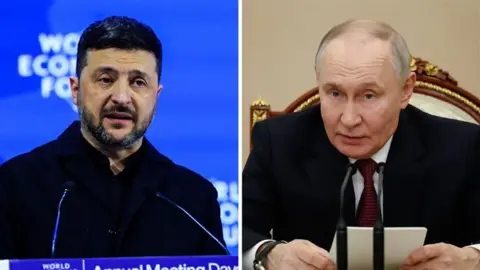
Pokrovsk has not fallen yet. That is despite President Vladimir Putin's recent claim that Russian forces have taken the city.
There is no doubt Ukraine has been losing ground in this key city in the east. For Russia, Pokrovsk is another stepping stone towards its goal of taking control of all of the Donbas. But Ukraine needs to prove it is still capable of resisting.
At a Ukrainian command post, well behind the front line, orders are relayed by radio in rapid and quick succession. Soldiers watch dozens of live drone feeds. They are coordinating strikes on Russian positions inside the city.
The commander of the Skala Assault Regiment, Yuri, is keen to prove to us that Ukraine still controls the north of the city - to show that the Kremlin's claim that it has taken Pokrovsk is a lie.
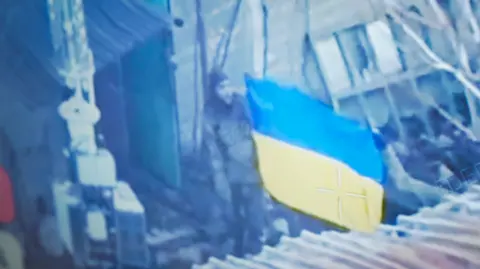
Over the radio, they ask two of their soldiers to break cover from a building to display a Ukrainian flag. They move quickly to avoid being spotted. The drone feed shows the moment they briefly wave their yellow and blue flag, before quickly returning to cover.
Yuri tells me: You've now seen it with your own eyes. I think the whole world should know we will not just give up our territory, he says. If we do not show this, everyone will lose faith and stop helping Ukraine.
The battle for Pokrovsk, once a key logistics hub for Ukraine's military, has been grinding on for nearly 18 months. The city is already in ruins.
Those tracking the Russian advances suggest Ukrainian forces barely have a hold on the city. Russian forces have slowly been advancing from the south. Ukraine is losing ground, but says it still holds the north, up to the railway line that bisects the city.
Sasha, a 25-year-old battalion commander, shows me a map. On top he has placed green plastic soldiers to represent where Ukrainian troops are still defending. Brown plastic soldiers show where their enemy has advanced.
The Russians have been using small teams of two to four soldiers to sneak past Ukrainian positions, sometimes dressed as civilians. It's a good tactic to get behind enemy lines, to gain a foothold, Sasha says. But he adds: The enemy who gets into our rear is quickly identified – it takes 15 to 20 minutes between detection and destruction.
Russia has suffered heavy casualties, but still has more troops. A Ukrainian soldier with the call sign Rabbit shows me passports and documents retrieved from their dead. I asked him if he thinks they have killed a lot of Russians. Not enough, he replies.
The fighting is clearly taking its toll on Ukrainian forces, but there is no sign of them giving up. Nor does Rabbit agree with any suggestion that Ukraine should give up more land for peace. He says too much blood has already been spilt: We are part of this land. If we give it up Russia will want more.
In Pokrovsk, Ukrainian soldiers are focused on the fighting, not peace talks. Most say they want to avoid political questions. But a volunteer from Latvia – the Skala Regiment's deputy commander – is more willing to give an opinion. He describes President Donald Trump as a charismatic and strong leader, but highlights the need for decisive action from the West, stating: there's a lot of talking, a lot of bureaucracy and not enough doing.
The message from the troops we talked to is that the situation in Pokrovsk is not so bleak. But Ukraine needs proof of its resolve at this critical time.