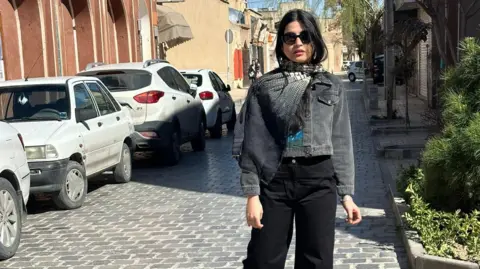
An Iranian woman who witnessed the bloody crackdown on protests in Iran has described how her neighbourhood turned into a war zone as security forces opened fire at crowds with live ammunition.
A government-imposed internet blackout in Iran, now in its third week, has prevented many accounts of what has happened from reaching the wider world.
But some Iranians who have left the country have been able to share what they have seen.
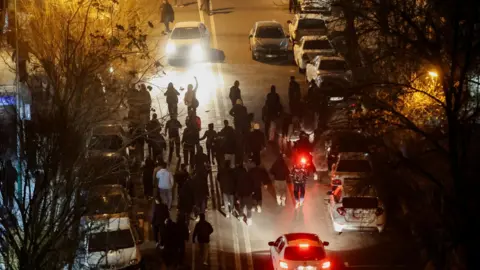
Parnia, who lives in London, told the BBC that she was visiting her family in the central city of Isfahan when the protests broke out in the capital, Tehran. They quickly spread across the country, and within days there were hundreds of protesters in the Hakim Nezami and Khaghani neighbourhoods of Isfahan.
There were women and men from seven to 70 years old, she said. On just one street there were 200 to 300 people. People were chanting 'Death to the dictator' and 'Long live the shah'... Isfahan has seen protests and crackdowns down the years. But Parnia said she had never seen anything like what happened during the recent unrest, which was sparked by anger over the collapse of the Iranian currency.
First, security forces fired tear gas at the protesters, she said. Then they formed a line and fired birdshot. I saw people getting shot and falling down, and I saw blood on the street. Parnia said she ran away down alleyways and was suddenly pulled into an apartment block by a woman. Inside, she said, were many injured protesters.
I saw the lobby floor covered in blood, and I saw a girl whose leg was full of pellets. Videos verified by the BBC from that night show large numbers of people in the streets in Isfahan. Some streets were blocked by traffic sign poles and large metal sheets, in an apparent effort by protesters to protect themselves from gunfire.
On Friday morning, 9 January, Khamenei said Iran would not back down from dealing with what he called destructive elements... Following Khamenei's speech, the powerful Revolutionary Guards sent a text message to people across Iran, telling them to avoid gatherings on streets in areas of unrest. Despite the risks, Parnia went out to protest again on Friday evening.
The protesters were hopeful, she said. You could see fear on everyone's faces. We were afraid to pass in front of the security forces and come closer together, said Parnia, who described a scene of total chaos at a local clinic that was treating wounded protesters. No phone lines were working. Nobody could call their families, and many refused to go to hospitals, fearing they could be arrested there. Parnia left Isfahan that same day and travelled to the capital, Tehran, to catch a flight back to London.
Since her return to the UK, Parnia has been in touch with her friends in Isfahan. She said she learned from a source that doctors at Feiz eye hospital in Isfahan had carried out around 300 surgical procedures to remove the eyes of patients with birdshot-related facial injuries. Many believe the true figures may be even higher.
Parnia said she was now preparing to join Iranian opposition protests in the UK, saying she wants to be a voice for the silenced protesters. Iranians have shown what they want in the streets and paid a high price for it.\