The US may want many of its foes gone from power. It doesn't usually send in the military and physically remove them.
Venezuela's abrupt awakening took two forms.
Its residents were woken abruptly to the sound of deafening booms: the sound of its capital Caracas under attack from US strikes targeting military infrastructure.
Its government has now woken up from any illusion that US military intervention or regime change was just a distant threat.
US President Donald Trump has announced Venezuela's leader, Nicolás Maduro, has been captured and flown out of the country.
This was a man who wielded a huge amount of power: his government controlled the electoral system, the judiciary, the military, as well as having the loyalty of powerful militia groups.
By the end of Saturday, he was pictured in a grey tracksuit, his hands bound, his eyes blindfolded, being transported to detention in the US. It was an extraordinary fall from power.
The US has long accused Maduro of leading a criminal trafficking organisation, something he strongly denies. It designated as a foreign terrorist group the 'Cartel de los Soles' - a name the US uses to describe a group of elites in Venezuela who it alleges orchestrate illegal activities like drug trafficking and illegal mining.
Maduro now faces a US trial over weapons and drugs charges.
For years, Maduro's government has been accused of human rights abuses. In 2020, United Nations investigators said its government had committed egregious violations amounting to crimes against humanity such as extrajudicial killings, torture, violence and disappearances - and that Maduro and other top officials were implicated.
Human rights organisations have recorded hundreds of political prisoners in the country, including some detained after anti-government protests.
These are reasons many in and outside the country wanted him gone, despite him still having some loyal followers. But that doesn't make Saturday's events straightforward.
The US has not carried out direct military intervention in Latin America like this since its 1989 invasion of Panama to depose the then-military ruler, Manuel Noriega.
This latest operation, striking inside a sovereign capital directly, is a dramatic escalation in US engagement in the region.
The forcible removal of Maduro will be hailed a major victory by some of the more hawkish figures within the US administration, many of whom have argued that only direct intervention could force Maduro from power.
Washington has not recognised him as the country's president since the 2024 elections. The opposition published electronic voting tallies after the vote that it said proved it, not Maduro, won the election.
The result was deemed neither free nor fair by international election observers. The opposition leader Maria Corina Machado was barred from running in it.
But for Venezuela's government, this intervention confirms what it has long claimed - that Washington's ultimate goal is regime change.
Venezuela has also accused the US of wanting to steal its oil reserves, the largest in the world, and other resources – an allegation it felt was vindicated after the US seized at least two oil tankers off the coast.
The strikes and capture come after months of US military escalation in the region.
Any doubts that remained that those operations were at least in part about regime change too have now been dashed by today's actions.
It remains deeply unclear what comes next inside Venezuela itself. Trump has claimed the US will now run Venezuela but has not clarified what he means by that.
Will the US try to push for fresh elections? Will it try to depose further senior members of the government or the military and force them to face justice in the US?
Trump said he was not afraid of putting boots on the ground and hinted bigger strikes could come if deemed necessary.
More surprisingly, he also said the opposition leader and Nobel Peace Prize winner Maria Corina Machado didn't have the support or respect in Venezuela to take power. She frequently praised Trump and they were allies. Many expected him to back her in any power transition.
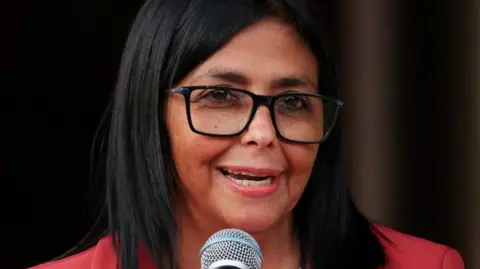
Instead, he insinuated he could instead work with Maduro's deputy Delcy Rodriguez, saying she was essentially willing to do what we think is necessary to make Venezuela great again.
Could this mean leaving power in exchange for not facing the same fate as Maduro? Or assuming power but allying with the US, including, for example, allowing more access to its vast oil reserves? And if so, how would other Maduro allies who have long accused the US of imperialist tendencies, and Venezuela's opposition who loathe Maduro's regime, react to that?
Ms Machado has said the opposition's 2024 election candidate Edmundo Gonzalez should assume the presidency and heralded this action as a day of freedom for Venezuela. There were celebrations among some Venezuelans in the country and overseas who feel this could mark the end of an authoritarian rule and pave the way for a much freer country.
Not everyone aligned with the opposition agrees, though. Some may be fierce critics of Maduro, but also deeply sceptical of US intervention in the country – not least because of the US's record of backing coups and regime change, some of which led to dictatorships and human rights abuses themselves.
Others warn this would not also be simple given the government's grip on power in the country.
It controls the judiciary, the Supreme Court, the military – and is aligned with powerfully armed paramilitaries known as colectivos.
Some fear US intervention could trigger violent fragmentation and a prolonged power struggle.
As for Trump, his administration has become increasingly muscular in the region with its financial bailout for Argentina, tariffs on Brazil to try to influence the coup trial of Trump ally and former president Jair Bolsonaro, and now the military intervention in Venezuela.
It remains to be seen what the broader implications of this intervention will bring on a geopolitical level, as the U.S. tries to balance its ideology with the realities on the ground in Venezuela.