In brief
Tariffs have changed the landscape of the global economy, prompting both growth and challenges. As the US seeks to enhance manufacturing while navigating ongoing trade tensions, significant geopolitical discussions loom. Insights from the IMF reveal a potential slowdown in global economic growth, influenced heavily by ongoing tariff disputes, especially between the US and China.
President Trump's favourite word is tariffs. He reminded the world of that in his pre-Christmas address to the nation.
With the world still unwrapping the tariffs gift from the first year of his second term in office, he said they were bringing jobs, higher wages, and economic growth to the US.
That is hotly contested. What is less debatable is that they've refashioned the global economy, and will continue to do so into 2026.
The International Monetary Fund (IMF) says that although the tariff shock is smaller than originally announced, it is a key reason why it now expects the rate of global economic growth to slow to 3.1% in 2026. A year ago, it predicted a 3.3% expansion this year.
For the head of the IMF, Kristalina Georgieva, things are better than we feared, worse than it needs to be. Speaking on a podcast recently she explained that growth had fallen from a pre-Covid average of 3.7%.
This growth is too slow to meet the aspirations of people around the world for better lives, she said.
Other forecasts for 2026 are even more pessimistic than that of the IMF.
Yet the impact of the tariffs on the global economy was not as bad as it could have been, notes Maurice Obstfeld of the Peterson Institute for International Economics. He emphasizes that countries didn't retaliate strongly against the US.
However, after five rounds of trade talks, the world's two biggest economies still have more tariffs and other trade restrictions in place against each other than when Trump took office for the second time.
These tariffs have raised costs for many businesses and increased uncertainty, complicating future planning and investment.
Despite some resilience, these frictions and uncertainties take their toll over time, leading to efficiency losses and reduced overall economic health.
The UN trade agency UNCTAD reports that global trade thrived amid tariffs, growing 7% last year and surpassing $35 trillion (£26 trillion).
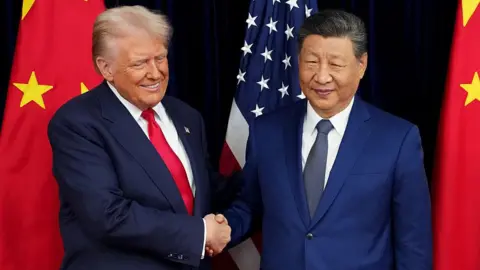
Tariffs, US sourcing of rare earth metals, and Chinese access to high-end US chips dominate discussions as both sides gear for future negotiations, especially a meeting slated for April 2026 between Presidents Trump and Xi. Areas of concern include manufacturing output management from China and the growing dependency of Europe on inexpensive Chinese imports.
Looking onward, numerous factors could influence the global economic climate, creating a complex fabric of trade and economic policy.