In brief
Google's Willow quantum computer, situated in a uniquely cold lab environment, holds the key to advancements in technology pivotal to the future of finance, artificial intelligence, and global economics. With its groundbreaking architecture and the potential for vast computational power, Willow represents a pivotal leap towards the quantum era.
It looks like a golden chandelier and contains the coldest place in the universe. What I am looking at is not just the most powerful computer in the world, but technology pivotal to financial security, Bitcoin, government secrets, the world economy, and more.
Quantum computing holds the key to which companies and countries win — and lose — the rest of the 21st Century.
In front of me suspended a metre in the air, in a Google facility in Santa Barbara California, is Willow. Frankly, it was not what I expected.
There are no screens or keyboards, let alone holographic head cams or brain-reading chips. Willow is an oil barrel-sized series of round discs connected by hundreds of black control wires descending into a bronze liquid helium bath refrigerator keeping the Quantum microchip a thousandth of a degree above absolute zero.
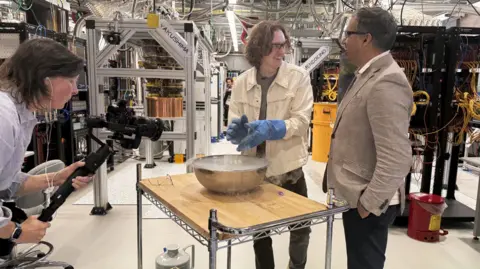
Welcome to our Quantum AI lab, says Hartmut Neven, Google's Quantum chief, as we go through the high-security door. His mission is to turn theoretical physics into functional quantum computers to solve otherwise unsolvable problems.
Neven holds up Willow, which has delivered significant milestones, including the ability to solve a benchmark problem in minutes that would take classical computers trillions of years. The lab's atmosphere is vibrant with art, reflecting the fusion of technology and creativity.
Secret Temple of High Science
Much of our conversation is about what we cannot film in this lab, which is subject to secrecy and export controls. Neven insists that these advances are crucial not only for technology but also for global economic supremacy. The Willow chip has 105 qubits, a significant step towards achieving utility-scale quantum computers.
Neven outlines several future applications including better medicine discovery, efficient food production, energy solutions, and tackling climate change. The implications extend to the security of cryptocurrencies, especially with the looming quantum threat to current encryption methods.
The Global Race
The competition in quantum technology is intensifying, with China's state-backed efforts significantly surpassing those of the West in terms of resources and output. The UK, meanwhile, strives to capitalize on its strong foundational research in quantum technology.
Parallel Universes?
Back at the Willow lab, existential discussions arise regarding the implications of quantum speed—could it indicate parallel universes? Neven suggests it may be time to consider such ideas seriously, adding a philosophical dimension to the groundbreaking science unfolding at Google.