Russia has confirmed that it used the Oreshnik ballistic missile as part of a massive overnight strike on Ukraine on Thursday night.
Four people were killed and 25 others injured in Kyiv, where loud booms could be heard for several hours, setting the sky alight with explosions.
It is only the second time that Moscow has used the Oreshnik, which was first deployed to hit the central city of Dnipro in November 2024.
Russia's defence ministry stated the strike was a response to a Ukrainian drone attack on Vladimir Putin's residence in late December, which Kyiv denies carrying out.
While the ministry did not specify what had been the Oreshnik's target, shortly before midnight (22:00 GMT), videos began circulating on social media showing numerous explosions on the outskirts of the western city of Lviv.
Ukrainian authorities confirmed that a ballistic missile had struck infrastructure in Lviv, about 60km (40 miles) from the Polish border.
The Oreshnik is an intermediate-range, hypersonic ballistic missile, capable of reaching up to 5,500km (3,417 miles). It is known for its warhead that fragments during its descent, causing distinctive repeated explosions moments apart.
Ukrainian foreign minister Andrii Sybiha labeled the strike a grave threat to European security, calling it a test for the transatlantic community.
The strike was launched in response to [Putin's] own hallucinations, he remarked, referring to the alleged drone attack on the president's home in December.
The EU has cast serious doubt on the occurrence of such an attack, with Donald Trump recently expressing skepticism about its validity.
As Lviv and other western regions were targeted on Thursday night, more than a dozen missiles and hundreds of drones were deployed during the attack on Kyiv.
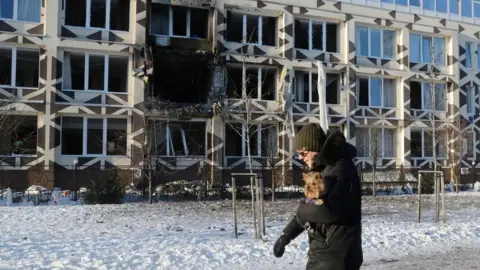
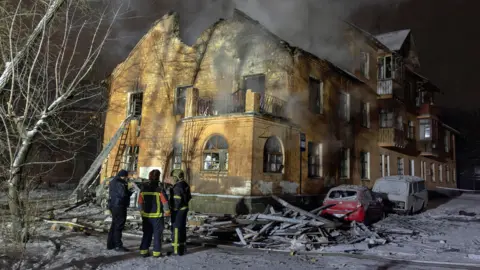
A paramedic was among those killed while arriving at a damaged apartment in Kyiv. The capital's mayor, Vitali Klitschko, described it as a double-tap strike—when a first attack is followed by a second, aimed at harming rescuers who respond.
Two apartment buildings along the east bank of the Dnipro River and a high-rise building in the city's central district were also targeted.
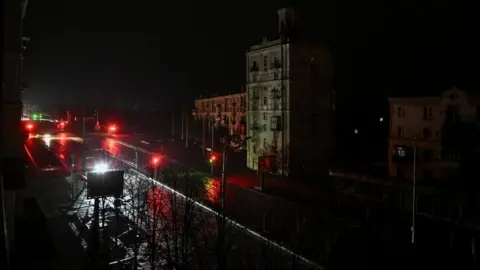
Power supply was disrupted in several of the city's neighbourhoods amid a harsh winter, with temperatures expected to drop to -15C (5F) this weekend.
The targeting of power plants has become a constant feature of this war, as Ukraine increasingly responds in kind to Russia's sustained attacks on energy infrastructure.
During the ongoing attack, half a million people in the Russian region of Belgorod lost power due to Ukrainian shelling of infrastructure, according to the local governor.
Ukrainian strikes also affected water and heating systems in the city of Oryol, further north, following a missile attack.