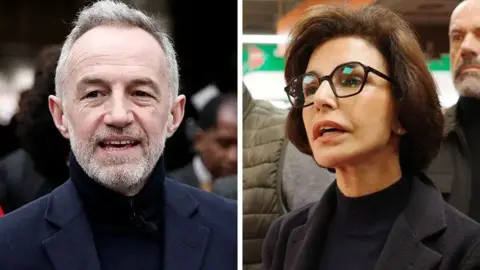
Mayors for France's major towns and cities will be chosen on Sunday, in the last vote before next year's presidential elections. Excitement is especially high in Paris and Nice. The capital could shift to the right after 25 years under a Socialist-led coalition, if Rachida Dati comes from behind in the opinion polls to defeat Emmanuel Grégoire. And on the Riviera, a hard-right ally of Marine Le Pen's National Rally (RN), Eric Ciotti, seems on course for victory.
But in this second round of municipal elections, the biggest focus across the country is on the hard-left party France Unbowed (LFI). In many of these places, it has now formed alliances with other left-wing lists – mainly from the Socialist Party (PS) or Greens – in order to concentrate the anti-right vote. The key test in these elections – of big importance ahead of 2027 – is whether voters favour or shun these alliances, given the growing criticisms aimed at LFI and its leader Jean-Luc Mélenchon for alleged antisemitism and pursuing a 'sectional' i.e Muslim vote.
This is illustrated in Toulouse, where centre-right mayor Jean-Luc Moudenc came first in round one, but is now threatened by merged lists of left-wingers François Piquemal from LFI and Socialist François Briançon, who are now positioned to potentially secure control of the city. Commentators note these developments as signs of Mélenchon’s growing confidence ahead of next year’s presidential election.
However, not every city has seen an all-left pact. In Paris, the Socialist Emmanuel Grégoire refused an alliance with LFI candidate Sophia Chikirou, who remains in the race. Meanwhile, the right-wing candidate Rachida Dati is benefiting from a weakened opposition, allowing her to close the gap on Grégoire.
As the political landscape continues to shift, the outcome of these elections could reshape the dynamics leading to the critical 2027 presidential vote, with significant implications for France’s political future.
But in this second round of municipal elections, the biggest focus across the country is on the hard-left party France Unbowed (LFI). In many of these places, it has now formed alliances with other left-wing lists – mainly from the Socialist Party (PS) or Greens – in order to concentrate the anti-right vote. The key test in these elections – of big importance ahead of 2027 – is whether voters favour or shun these alliances, given the growing criticisms aimed at LFI and its leader Jean-Luc Mélenchon for alleged antisemitism and pursuing a 'sectional' i.e Muslim vote.
This is illustrated in Toulouse, where centre-right mayor Jean-Luc Moudenc came first in round one, but is now threatened by merged lists of left-wingers François Piquemal from LFI and Socialist François Briançon, who are now positioned to potentially secure control of the city. Commentators note these developments as signs of Mélenchon’s growing confidence ahead of next year’s presidential election.
However, not every city has seen an all-left pact. In Paris, the Socialist Emmanuel Grégoire refused an alliance with LFI candidate Sophia Chikirou, who remains in the race. Meanwhile, the right-wing candidate Rachida Dati is benefiting from a weakened opposition, allowing her to close the gap on Grégoire.
As the political landscape continues to shift, the outcome of these elections could reshape the dynamics leading to the critical 2027 presidential vote, with significant implications for France’s political future.