In brief
Gina Russo's experience in the 2003 Station nightclub fire parallels the recent tragedy at Le Constellation bar in Switzerland, where rapid flashover conditions led to significant loss of life. Both incidents highlight critical fire safety lapses and a need for improved preparedness among patrons.
Warning: This article contains themes you may find upsetting
Gina Russo was watching a gig with her husband-to-be, Fred Crisostomi, one night in 2003 when she realised something wasn't right. Great White, an 80s hair-rock band, had opened their set with a thrash of guitar chords, as four large pyrotechnic flares shot out from the stage, quickly igniting acoustic foam panels surrounding them.
It was immediate, Gina recalled. She and Fred fought through a growing crowd toward an exit, only for their path to be blocked by a bouncer. As panic set in and the crowd surged towards safety, she remembers a horrible stampede leading to bodies piling up. Gina’s last memory was escaping through a door before losing consciousness.
After weeks in an induced coma, she woke to find out that Fred had heroically pushed her to safety but tragically lost his own life in the inferno.
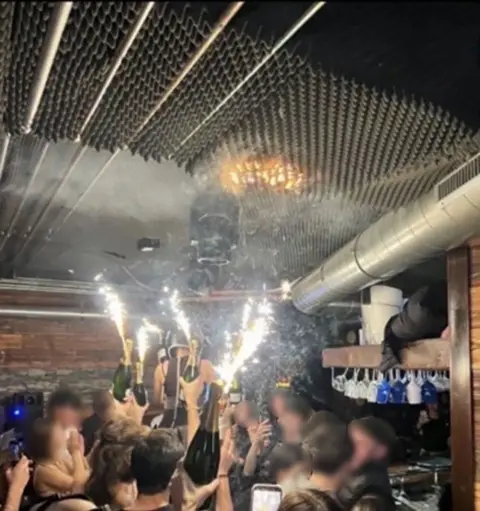
Two decades later, a similar disaster struck Le Constellation bar in Switzerland on New Year's Day 2026, resulting in the loss of 40 lives, echoing the tragedy of The Station nightclub where 100 perished. Both fires were set off by indoor pyrotechnics and resulted in flashover fires—a condition where intense heat and smoke rapidly engulf a room.
Experts compare the fire at Le Constellation to The Station fire, indicating an urgent need for better fire safety measures in public venues, raising questions on how to effectively escape in such rapidly deteriorating situations.
Reports suggest that both venues had flammable materials contributing to the speed of the fire. Fire investigation indicates that in just 90 seconds, conditions became lethal, emphasizing that the time to escape was alarmingly short.
In both cases, survivors expressed a common theme—an underestimation of fire's rapid development. Many, conditioned to think of safety measures as available, hesitated to act until it was too late. Experts stress the importance of awareness and preparedness in fire situations, urging patrons to always find escape routes proactively.
As victims from both disasters continue to fight their personal battles and advocate for better safety standards, questions loom large about the lessons left unlearned. Gina Russo and Phil Barr, both of whom survived The Station fire, emphasize that the scars from such tragedies linger long after the flames have been extinguished.