In brief
In recent weeks, Russians have begun to push back against the government's increasing control over the internet, evidenced by petitions submitted to President Putin and growing public protests. Many citizens, facing disruption to essential services and communication platforms, express fear and frustration about escalating internet restrictions that have begun to feel like a digital 'Iron Curtain'. Activists and ordinary citizens alike are adapting to these challenges while voicing concerns over governance and the future.
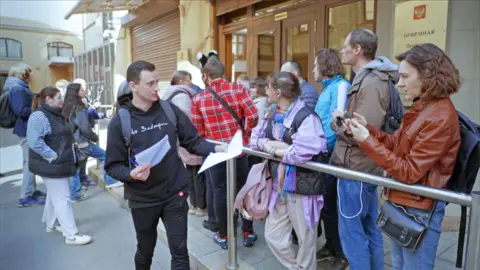
Near the Kremlin several dozen people are queuing outside the presidential administration office.
They've come to submit petitions calling on President Vladimir Putin to end a crackdown on the internet.
Russian authorities have been tightening control of the country's cyber space. Access to global messaging apps has been restricted and there are widespread disruptions to, even shutdowns of, mobile internet.
Petitioning the president is legal. But in an authoritarian state this is putting your head above the parapet.
And people are being made to feel that.
From across the street security officers are filming the petitioners – and us.
Aren't you scared? I ask Yulia in the queue.
Very scared, she replies. I'm shaking.
Putin has acknowledged the disruption, describing it as related to operational work to prevent terrorist attacks, although he says he has instructed officials to allow for the uninterrupted operation of essential internet services.
Yulia, who owns a catering company, explains how attempts to censor the internet have affected her business. There were times recently when our website was not accessible. We couldn't generate revenue, she says. We are losing money every time there is a blocking of the internet, a blocking of [messengers] Telegram and WhatsApp. My business is entirely on the internet. Without internet access, in this form it will not exist.
Russian officials insist that curbs on communication are in the interests of public safety. They claim that mobile internet blackouts disorient Ukrainian attack drones, although such attacks have continued even in areas where the internet has been switched off.
The authorities accuse global messengers of ignoring Russian data laws. Access to WhatsApp and Telegram has been heavily restricted. Meanwhile, state regulators are targeting VPNs - virtual private networks used to circumvent restrictions.
As part of the push for a sovereign internet, the government is promoting a state-backed Russian messenger called MAX. The public is wary.
Similar applications for public protests were rejected in dozens of Russian towns and cities. The longer we chat, though, the less Maria seems to want up-to-date information. In the past, when there was no internet, the world seemed a brighter place, because we knew less, she tells me.
Just how much the increasing restrictions resonate with citizen sentiment is evolving, with signs of growing discontent that could impact the Kremlin's grip in the future.