In brief
Scientists from an international team reported that limb bones from a 115‑million‑year‑old theropod in northeastern Brazil contain mineralized red blood cells and intact heme biomolecules, the oldest proof of ancient blood. The finding challenges the view that hemoglobin could not survive deep time and offers new insights into early vertebrate physiology and the preservation processes that may have protected these molecules.
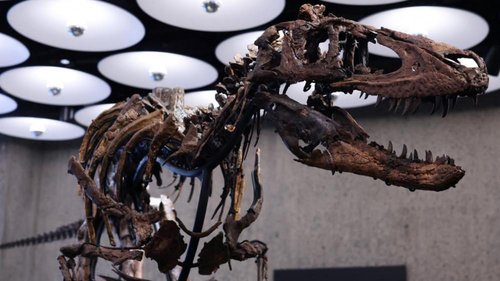
On Nov. 4, a team of scientists announced that a 115‑million‑year‑old theropod dinosaur limb bone from northeastern Brazil preserves fossilized red blood cells and collagen, the earliest confirmed evidence of ancient hemoglobin molecules.
The study, released by Curtin University in Australia, detailed how the bones contain numerous mineralized red blood cells within vascular canals, preserving heme biomolecules that prove the presence of hemoglobin in the original organism.
Researchers found that the cells had been mineralized with hausmannite, a mineral that is thought to have shielded the delicate cellular structures and chemical signatures from degradation over millions of years.
The discovery was made by an international consortium that includes scientists from Japan, Brazil, and the United States, all of whom contributed to the excavation, analysis, and chemical testing of the fossil material.
Lead author Kliti Grice, a distinguished professor at Curtin University, noted that the findings "challenge longstanding assumptions that biomolecules such as hemoglobin could not survive deep time," according to the release.
Experts explain that the exceptional preservation likely occurred because the dinosaur was rapidly buried in a low‑oxygen, microbially rich environment shortly after its death, conditions that inhibited bacterial decay.
Published in the peer‑reviewed journal Proceedings of the National Academy of Sciences, the research represents the first chemical confirmation of cellular hemoglobin within dinosaur fossils, overturning earlier studies that only suggested possible red‑cell structures.
The study opens new avenues for scientists to investigate how blood evolved in ancient vertebrates, including metabolism, activity levels, and the role of blood chemistry in the physiology of long‑extinct species.
Furthermore, the preservation mechanisms identified may inform the search for ancient life on other planets, as similar biomolecule retention processes could be detectable in extraterrestrial contexts.
While this discovery does not represent the first time fossilized biomolecules have been found, it stands out as the oldest unequivocal evidence of red blood cells preserved in a dinosaur skeleton.
Future research will focus on examining additional fossils from the same formation to determine how widespread this preservation phenomenon might be and to refine models of biomolecule survivability across geological timescales.