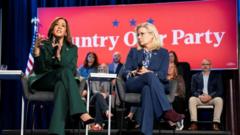
Kamala Harris spent Monday directly targeting independent and Republican voters in crucial states that form the Democratic Party’s “blue wall.” In an effort to reach anti-Trump Republicans, Harris visited Pennsylvania, Michigan, and Wisconsin alongside Liz Cheney, a former Congresswoman known for her opposition to Donald Trump.
Two weeks ahead of the election, Harris opted for a “town hall” format rather than her usual rally-style events, engaging in discussions moderated by Republican figures. These included pollster Sarah Longwell in Pennsylvania, commentator Charlie Sykes in Wisconsin, and Maria Shriver, niece of JFK, in Michigan. The choice of suburban venues highlighted their effort to attract college-educated, traditionally Republican voters who have recently shown a tendency to lean Democrat.
The shifting political coalitions in the Trump era were evident. Craig Snyder, a Republican strategist supporting Harris, stated that many disaffected Republicans are eager to hear from their peers rather than solely from Democrats. Cheney echoed this sentiment, emphasizing the importance of voting one’s conscience, stating, “There will be millions of Republicans who will do it.”
At the town halls, Cheney noted that many Republicans secretly appreciate her critique of Trump. Harris noted that she witnessed Republicans approaching Cheney to express their gratitude for her stances, signaling a potential, albeit hidden, support for a break from Trump.
The audiences were staged to appear composed mainly of Republicans and undecided voters, yet the pre-selected questions allowed Harris to articulate her campaign messages effectively. For instance, she answered personal concerns about elder care in Pennsylvania and foreign policy issues regarding Ukraine. Additionally, the topic of abortion opened the floor for Cheney to comment on the Republican stance on reproductive rights.
Polls indicate a neck-and-neck race for the presidency, particularly in battleground states. The traditionally Democratic “rust belt” states remain critical, as Democrats won them back in the recent election cycle despite Trump flipping them in 2016. Currently, fewer than 10% of Republicans are showing support for Democratic candidates. However, if Cheney’s belief that there are “shy Republicans” willing to vote Democratic is accurate, Harris might find a more favorable path to the White House.
The Harris campaign's initiative to engage with these voters signals the importance of addressing soft support for Trump in pivotal regions as the election approaches.