In brief
Venezuela's ambassador to the UN has condemned the US for recently seizing Venezuelan oil tankers, calling it a form of extortion and illegal aggression. The meeting comes as tensions escalate over US military actions in the region, with President Trump ordering a blockade on sanctioned Venezuelan vessels.
Venezuela has accused the United States of the greatest extortion at an emergency session of the UN Security Council in New York.
Washington's seizure of two Venezuelan oil tankers was worse than piracy, the Venezuelan ambassador to the UN said.
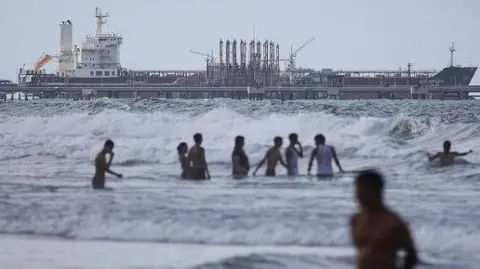
The emergency meeting of the Security Council was called to discuss the seizure of the tankers, which took place off the coast of Venezuela earlier this month.
The US has also said it was pursuing a third Venezuelan oil tanker.
President Trump has accused Venezuela's President Nicolas Maduro of leading a drugs cartel and said gangs had operated with impunity for too long.
On 16 December, Trump ordered a naval blockade of all sanctioned oil tankers entering and leaving Venezuela.
The US president has said the US will keep or sell the crude oil it has taken, as well as the vessels themselves.
The US has been building up its military presence in the Pacific and Caribbean Seas in recent months, sending 15,000 troops and a range of aircraft carriers and warships to the area.
It is the largest deployment to the region since the US invaded Panama in 1989, and the stated aim is to stop the flow of fentanyl and cocaine to the US.
Venezuela's envoy to the UN said the US was subjecting his country to the greatest extortion in its history.
During the Security Council meeting, Samuel Moncada stated, we are in the presence of a power that acts outside of international law, demanding that Venezuelans vacate our country and hand it over.
He denounced the US seizure of Venezuelan oil as pillaging, looting and recolonisation of Venezuela.
In response, the US Ambassador to the UN, Michael Waltz, claimed the US does not recognize Maduro as the legitimate leader of Venezuela, asserting that Maduro's ability to sell oil fuels his power and drug-related activities.
This ongoing situation highlights the tense geopolitical landscape surrounding Venezuela and raises questions about international law and sovereignty in the face of foreign intervention.