In brief
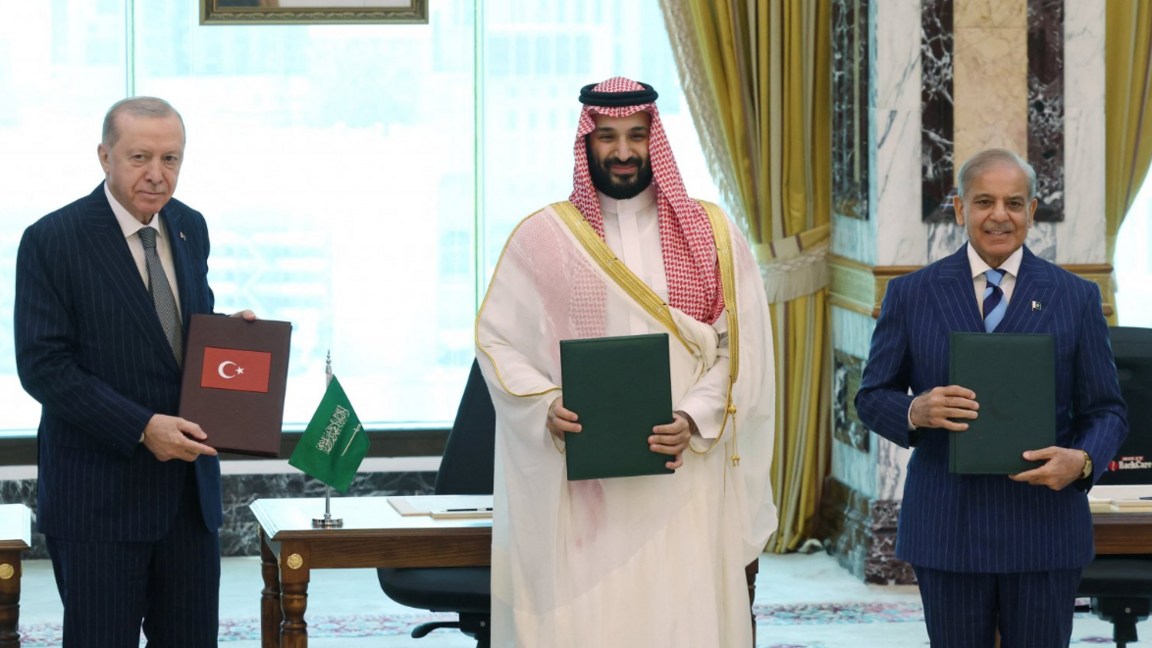
In Mecca on 7 August 2026, Saudi Crown Prince Mohammed bin Salman, President Recep Tayyip Erdogan and Prime Minister Shehbaz Sharif signed a tripartite defence agreement pledging that an attack on any one nation would be treated as an attack on all. The pact emerges amid heightened tensions following U.S. and Israeli strikes on Iran and subsequent retaliations that disrupted Gulf shipping lanes. While the treaty promises enhanced deterrence and defence cooperation, critics argue that it lacks detailed obligations, sparking uncertainty about how the alliance would operate in real conflict scenarios. The alliance signals a strategic pivot by Saudi Arabia and Turkey in response to regional upheavals, and it positions Pakistan as a pivotal diplomatic player amid its own tensions with India.
Saudi Arabia, Turkey, and Pakistan Sign Joint Defence Pact
On 7 August 2026, three of the world’s most influential Muslim states sealed a historic agreement in the holy city of Mecca. Crown Prince Mohammed bin Salman, President Recep Tayyip Erdogan and Prime Minister Shehbaz Sharif declared that an armed assault on any one of their nations would be treated as an assault on all three. The pact, formally titled the "Mecca Joint Defence Agreement", marks a new level of security cooperation in a region already strained by conflict.
The signing took place at a high‑profile ceremony that followed the United States and Israel’s retaliatory strikes on Iran on 28 February, which spurred Tehran‑backed forces to target Saudi and Gulf facilities and to interfere with maritime traffic through the Strait of Hormuz and the Red Sea.
Iran reacted sharply. Senior National Security Commission member Ebrahim Rezaei tweeted that the agreement would not improve Saudi security and warned that unilateral American military actions had historically been ineffective for their own security.
The alliance builds on a previous Saudi‑Pakistan defence pact of 2025, expanding the three‑side guarantee. Officials say the treaty will "strengthen collective deterrence against any act of aggression" and "enhance all aspects of defence cooperation". However, precise responsibilities for each member remain undefined, and a Turkish spokesperson described the pact as "purely defensive in nature".
For Saudi Arabia, the agreement offers extra security amid regional upheaval sparked by U.S. and Israeli operations against Iran. In the past month, Houthi rebels—backed by Iran—launched a maritime embargo against Saudi Arabia, targeting its airports, oil facilities, and Red Sea tankers. The pact also signals Saudi's strategic balancing as it seeks to avoid deeper entanglement in the U.S.–Iran conflict.
Pakistan benefits by bolstering its security portfolio. With its long‑standing tension with India increasing toward open conflict in May 2025, the alliance’s backing from Saudi’s economic clout and Turkey’s military-industrial capabilities provide significant leverage. Pakistan has also risen in global diplomatic stature, acting as a mediator between Iran and the U.S. and hosting ceasefire talks.
Turkey’s angle lies in expanding its defence industry prospects. According to RUSI analyst Burcu Ozcelik, the partnership offers opportunities for joint production, technology sharing, procurement, and greater military interoperability.
While the treaty ostensibly offers mutual security, the practical application in real conflict remains uncertain. Queries arise: would Turkey join Saudi in a resumed war against Yemen? Would Saudi invoke war on India if the India‑Pakistan conflict flares again? The complexities of such scenarios highlight the need for careful diplomacy to avoid escalation.
Ultimately, the discussion gravitates toward deterrence. By aligning themselves behind one another’s security, the trio may not eliminate aggression but can make the costs of an attack considerably higher, thereby shaping the decision calculus of potential adversaries.