In brief
The baby mammoth, estimated to have died when it was just one year old, was found in a remote Siberian crater and is being studied for insights into prehistoric life.
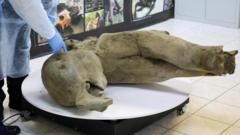
Russian scientists have made a groundbreaking discovery with the unveiling of "Yana," the remains of a baby mammoth that lived approximately 50,000 years ago. Found in the thawing permafrost of the Yakutia region during the summer, Yana's remarkably preserved carcass is considered the best-preserved mammoth ever discovered.Weighing over 100 kg (15st 10lb) and measuring 120 cm (4ft) in height and 200 cm in length, Yana is believed to have been only one year old at the time of her death. The finding took place in the Batagaika crater, the largest permafrost crater in the world. Local residents were fortunate to stumble upon the nearly thawed remains and took it upon themselves to use a makeshift stretcher to extract the mammoth from the earth.According to Maxim Cherpasov, head of the Lazarev Mammoth Museum Laboratory, while the forelimbs of the mammoth had been consumed by modern scavengers, Yana's head is in astonishingly good condition. Researchers speculate that the mammoth likely became trapped in a swamp, which inadvertently aided in its preservation over millennia.Yana is currently being analyzed by scientists at the North-Eastern Federal University in Yakutsk, where tests will determine the exact timing of her death. This find is one of many recent discoveries in Russia, as climate change is causing the once permanent frozen ground to melt. In addition to Yana, scientists have found remains of a 32,000-year-old sabre-tooth cat and a 44,000-year-old wolf in the very same region, sparking excitement and renewed interest in prehistoric life and environmental change.