In brief
In Central Kalimantan, Indonesia, billions of acres of forests and peatlands have burned, creating a thick, rust‑colored haze that suffocates communities. Families such as Dianyra Eka Nastiti’s are forced to stay indoors as the air turns into a portal of carbon monoxide and ultrafine particles that threaten lungs and brains alike. Health ministries report over 277,000 cases of respiratory illness, with children and pregnant women most exposed, while firefighters battle smouldering underground fires that resurface every week. With government resources stretched thin and rainfall delayed by a Super‑El Nino, the struggle to extinguish the blaze remains a gripping emergency for the region.
When the sun hits the smog that blankets Indonesian Borneo, the landscape turns a rust‑brown hue, creating an apocalyptic scene that feels surreal.
Dianyra Eka Nastiti, a mother of three living in Palangkaraya, watches the sky turn amber by night and worries that the air will choke her babies. “Her baby's chest makes a rattling sound sometimes at night,” she says, recalling how her infant was hospitalised with bronchopneumonia at 1.5 months of age.
Central Kalimantan has seen almost 1.9 million hectares of forest and peatlands consumed since the start of 2026, about the size of New Jersey. The fires spit microparticles and carbon monoxide that have driven 277,000 cases of chronic cough and acute respiratory illness, 62,000 of whom are children under five.
Residents report a sky thick as yellow custard, breathing air that is little more than a mélange of CO₂ and fine smoke. Riduan, the head of the local health office, laments that the brain’s oxygen supply is being strangulated, leading to headaches and long‑term lung damage.
Living on the frontline, Dianyra cannot afford to lock her family inside all day. “I need to buy vegetables, stock up on food and send children to school,” she says, “but the haze makes that impossible.”
Farmers, street vendors and other wage earners face a similar dilemma: either risk health or give up livelihoods. “We are forced to stay strong through the haze, because there is no option otherwise,” tells Lola Macitri of Ramang village.
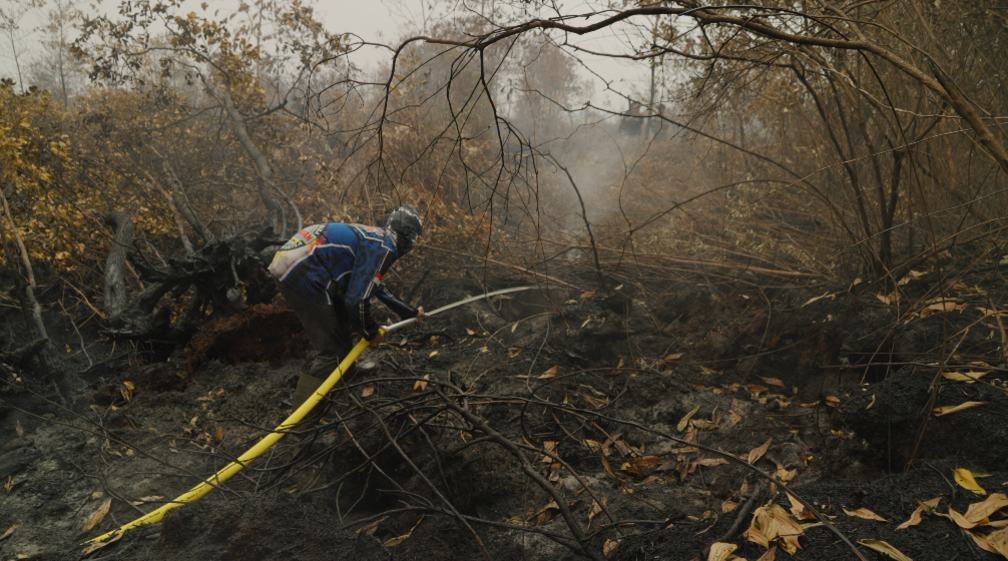
Ministerial responses have included aerial waterbombing and experimental weather modification, with the government claiming 60,000 personnel were deployed to a “land operation” that has achieved an 80 % success rate in extinguishing new fires. Yet fire crews like Juni report that underground peat continues to smoulder, while water scarcity due to drought makes extinguishing them increasingly difficult.
Forestry expert Dr Nisa Novita compares the situation to a sinking ship: “We need to act urgently, use whatever tools can help, and prevent further damage while we can.” She notes fires spreading into fire‑free areas and stresses that resources are depleting on the ground.
With a Super‑El Nino intensifying the drought, the clouds of smoke have deepened from dusty grey to burnt orange, striking the lives of thousands across Indonesia and neighbouring Southeast Asian countries. The hope now rests on an unexpected turn of rain and the collective will of the community, military, and police to finally put out the blaze.