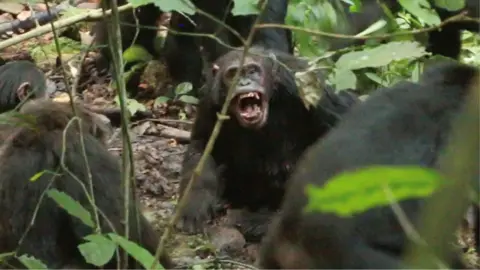
The world's largest known group of wild chimpanzees has split and been locked in a vicious civil war for the last eight years, according to researchers.
It is not clear exactly why the once close-knit community of Ngogo chimpanzees at Uganda's Kibale National Park are at loggerheads, but since 2018 the scientists have recorded 24 killings, including 17 infants.
These were chimps that would hold hands, lead author Aaron Sandel said. Now they're trying to kill each other.
The study published in the journal Science, says the intensity and duration of the violence may inform how early human conflict developed.
Sandel explained that chimpanzees are very territorial and have hostile interactions with those from other groups, likening their behavior to a fear of strangers.
However, for decades prior, the nearly 200 Ngogo chimpanzees lived in harmony, divided into Western and Central sets but functioning as one cohesive group.
Sandel observed the polarization's onset in June 2015, noting increased aggression and avoidance following initial disputes. A split occurred in 2018 when violent confrontations began, leading to numerous attacks with significant casualties.
Various factors, including the deaths of key group members and changes in social hierarchy, may have contributed to this aggression, with many researchers calling for a reevaluation of human conflict dynamics based on the chimpanzees’ behaviors.
As Sandel noted, In the case of the Ngogo fission, individuals who lived, fed, groomed, and patrolled together for years became targets of lethal attacks on the basis of their new group membership. This suggests that relational dynamics might play a larger role in fostering conflict than traditionally assumed.
Experts urge humans to learn from these findings, particularly regarding the consequences of group divisions in both non-human and human societies alike.