In brief
Research conducted over the past eight years reveals that the Ngogo chimpanzees in Uganda, once a cohesive group, have devolved into a civil war characterized by violent clashes and notable fatalities. This research provides insight into the complexities of chimpanzee behavior and draws parallels to human conflict.
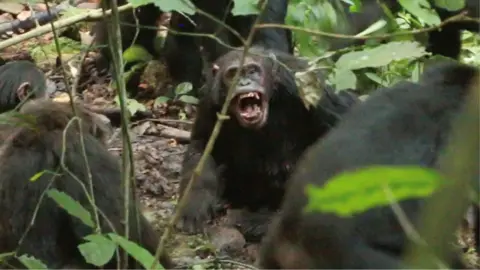
The world's largest known group of wild chimpanzees has split and been locked in a vicious 'civil war' for the last eight years, according to researchers. It is not clear exactly why the once close-knit community of Ngogo chimpanzees at Uganda's Kibale National Park are at loggerheads, but since 2018, scientists have recorded 24 killings, including 17 infants. 'These were chimps that would hold hands,' lead author Aaron Sandel said. 'Now they're trying to kill each other.' This study, published in the journal Science, discusses how the intensity and duration of this violence may inform our understanding of the origins of human conflict.Sandel, an anthropologist from the University of Texas and a co-director of the Ngogo Chimpanzee Project, noted that chimpanzees are inherently territorial and often engage in hostile interactions with other groups. Over several decades, the nearly 200 Ngogo chimpanzees had lived harmoniously within two subgroups known as Western and Central. However, tensions began to escalate in June 2015, which led to an eventual six-week avoidance period between the two sets.The study identifies three potential catalysts for this aggression: the death of key individuals disrupting social ties, a disruptive change in the alpha male leadership, and a deadly respiratory epidemic that further isolated the groups. The researchers conclude that understanding these dynamics in chimpanzee societies can shed light on the factors that lead to conflict in human societies as well.