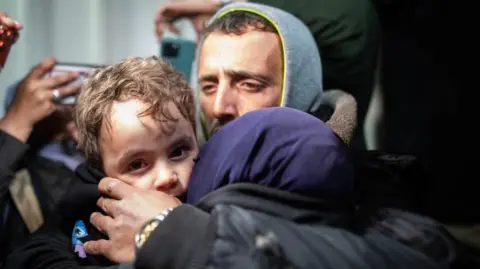
Two Gazan women who passed through the newly reopened Rafah crossing with Egypt on Monday have described a surprising encounter with a local Palestinian militia linked to Israel conducting checks at an Israeli military checkpoint inside the Gaza Strip.
Lamia Rabia, traveling with her children, reported being escorted by Israeli forces to a checkpoint where members of the Abu Shabab militia, also known as the Popular Forces, carried out searches of their bags and belongings. There was a woman from the Abu Shabab group who conducted the searches on the women, she told the BBC.
While the militia did not engage in conversation during the searches, Rabia recounted that after the militiamen, they were moved to a separate area for questioning by Israeli authorities. She noted that both the Israelis and the Abu Shabab group were present at the checkpoint, suggesting a potentially coordinated effort. The BBC has reached out to the Israel Defense Forces (IDF) for clarification, but they declined to comment on the relationship with the militia.
The Abu Shabab militia operates as an anti-Hamas group, reportedly receiving support from Israel to help maintain control within the Rafah area. Ghassan al-Dheini, the group's leader, had previously indicated their expanding role in securing the crossing.
The experience of crossing was markedly different for each woman. While Rabia described an easy process, another unnamed woman claimed that she was mistreated, alleging that she and several others were physically abused and sought after inappropriately as part of their crossing. Her accounts underscore the complex and potentially dangerous environment surrounding the crossings.
Officials had predicted that around 50 individuals would be able to make the crossing in each direction, but only 12 were reported to have successfully returned on that occasion, despite pre-screening by authorities. As confusion persisted over the reopening process and travel limitations, support and oversight from European Union monitors present at the crossing were called into question.
With over 20,000 Palestinians in need of medical evacuations, the reopening of Rafah represents a critical new chapter for the region but highlights the ongoing tensions and organizational challenges faced as it feels the impact of both local and international oversight.