Israel says it has agreed to reopen the Gaza Strip's key border crossing with Egypt only after an operation to retrieve the body of the last remaining Israeli hostage in the territory is complete.
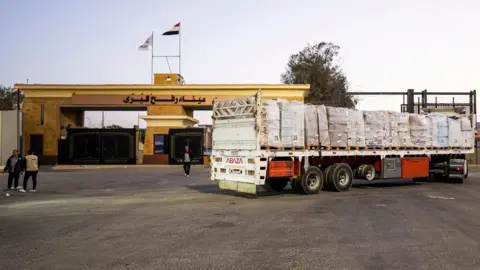
The Rafah crossing has been mostly closed since May 2024, when the Palestinian side was seized by Israeli forces. It was meant to have reopened during the first stage of the ceasefire between Israel and Hamas, which began in October.
However, the Israeli government has made that conditional on Hamas making every effort to return the body of the last hostage, police officer Master Sgt Ran Gvili.
On Sunday, Israel's military said it had begun a new search for his remains in northern Gaza.
Although in its latest announcement, Israel appears to offer a timeframe for the reopening of the crossing, it is not known how long the search for Gvili will take.
Israeli media quoted military officials as saying the operation was taking place at a cemetery in Gaza City and that it could last several days.
On Thursday, the head of the new technocratic Palestinian government in Gaza said the Rafah crossing would open in both directions this week.
It comes as US and other mediators continue to press both sides to take the next steps to advance President Donald Trump's peace plan.
On Sunday night, Israeli Prime Minister Benjamin Netanyahu's office announced that Israel had agreed to a limited reopening of the Rafah crossing for pedestrian passage only, subject to a full Israeli inspection mechanism.
The Israeli military was currently conducting a focused operation to exhaust all of the intelligence that has been gathered in the effort to locate and return the remains of Ran Gvili, a statement said.
Upon completion of this operation, and in accordance with what has been agreed upon with the US, Israel will open the Rafah crossing.
Israel's Haaretz newspaper cited a source as saying there would be a full Israeli monitoring mechanism at the crossing, which would include oversight of entry and exit lists.
Earlier on Sunday, the Israeli military said troops had begun a targeted operation in the area of the Yellow Line in the northern Gaza Strip to retrieve Gvili's body.
Israeli military officials told local media that the operation was acting on intelligence collected over a long period of time, which indicated that Gvili's remains might have been buried in the Shejaiya and Daraj Tuffah areas of Gaza City, east of the Yellow Line.
Hamas's military wing, the Izzedine al-Qassam Brigades, said on Sunday that it had provided mediators with all the details and information in our possession regarding the location of Gvili's body.
Gvili's family meanwhile reiterated their strong opposition to the reopening of the Rafah crossing before his body had been returned to Israel for burial.
The 24-year-old was killed in Kibbutz Alumim during the Hamas-led attack on southern Israel on 7 October 2023 and his body was taken back to Gaza as a hostage.