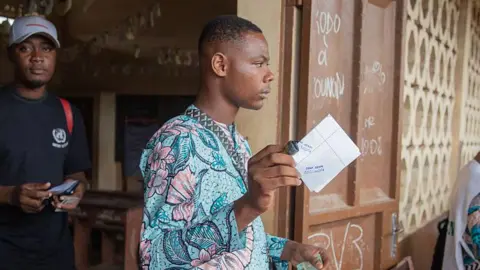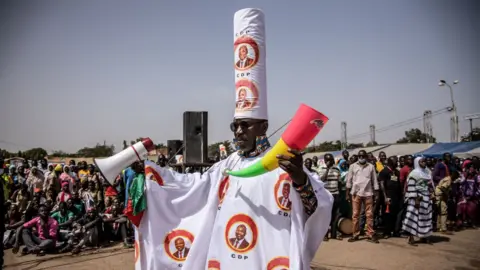
Burkina Faso's junta has announced a ban on all political parties, whose activities have been suspended since the military seized power in 2022.
Junta leader Captain Ibrahim Traoré has been criticized for suppressing dissent and the move will be seen as the latest attempt to tighten control.
According to Burkina Faso's Interior Minister Emile Zerbo, the ban is part of plans to rebuild the state after what he said were numerous abuses in the country's multiparty system.
Zerbo stated that the existing system had been promoting division among citizens and weakening the social fabric.
Previously, political parties were already prohibited from holding public gatherings, but this new decree halts them from functioning altogether.
All assets of the dissolved parties would be transferred to the state, and Zerbo added that a draft law would soon be sent to the Transitional Legislative Assembly.
Before the coup, Burkina Faso had over 100 registered political parties, of which 15 were represented in parliament following the 2020 elections.
This will not help the country move forward. We're not happy with this, a member of a civil society group, who requested anonymity fearing reprisals, told the BBC.
The regime is perceived to suggest that democracy is redundant in Burkina Faso. Observers note that Traoré may be consolidating power for the long haul, but history indicates that no leader can be secure indefinitely, as the possibility of another coup remains.
Although the ban faced some criticism on social media, several Burkinabes expressed support for the junta's decision, pointing to the chaos caused by having an excessive number of political parties.
Captain Ibrahim Traoré's military coup ousted his predecessor Paul-Henri Sandaogo Damiba after just nine months in power. Traoré had initially promised to restore a civilian government by July 2024 but has since announced an extension of military rule for an additional five years.
Despite his authoritarian approach, Traoré has garnered substantial support across the continent, particularly due to his pan-Africanist vision and critique of Western influence. The recent events in Burkina Faso resonate with a pattern witnessed in several West African nations, where military takeovers coincide with the suppression of political parties and electoral practices.