In brief
A recent discovery on the Indonesian island of Sulawesi reveals the oldest known cave painting—a red outline of a hand estimated to be 67,800 years old. This finding shifts the narrative of human creativity, suggesting advanced symbolic thought existed far earlier than previously believed and challenges the Eurocentric view of art's development. Researchers assert that these artistic expressions indicate that modern humans had a deep-seated capacity for creativity and symbolic representation, much earlier than the assumed timeline involving Europe.
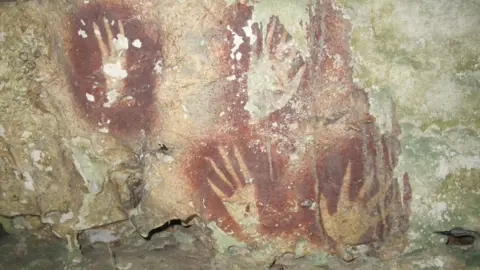
A stencilled outline of a hand found on the Indonesian island of Sulawesi is the world's oldest known cave painting, researchers say.
It shows a red outline of a hand whose fingers were reworked to create a claw-like motif, indicating an early leap in symbolic imagination. The painting has been dated to at least 67,800 years ago, roughly 1,100 years before the previous record held by a controversial hand stencil in Spain.
This discovery reinforces the idea that Homo sapiens had reached the Sahul region (ancient Australia–New Guinea) by about 15,000 years earlier than some researchers argue.
Over the last decade, finds on Sulawesi have dismantled the belief that art and abstract thinking emerged suddenly in Ice Age Europe. Cave art is seen as a critical marker of when humans began to think in ways that transcend mere reaction to their environment, showcasing storytelling and identity in unprecedented forms.
Professor Adam Brumm, co-leader of the project, emphasized that this discovery challenges the long-held Eurocentric narrative of a sudden creative explosion in Europe. Instead, it suggests creativity was inherent to our species, with evidence tracing back to Africa, where we evolved.
The latest artwork comes from Liang Metanduno cave, where a hand was pressed against the wall and pigment was blown around it, leaving a negative outline. Notably, the fingers were intentionally altered to appear claw-like, reflecting a capacity for creative expression absent in the art of Neanderthals.
Previous finds in Sulawesi include hand stencils and animal figures dating back at least 40,000 years. This new evidence extends the timeline, suggesting that the artistic practice on Sulawesi was deeply embedded among cultures in the region, rather than being sporadic or localized.
The findings underscore the need to reassess when and how symbolic behaviors emerged among early humans. The implications of these discoveries reach beyond Sulawesi, reshaping our understanding of human migration and the spread of creativity across ancient populations.