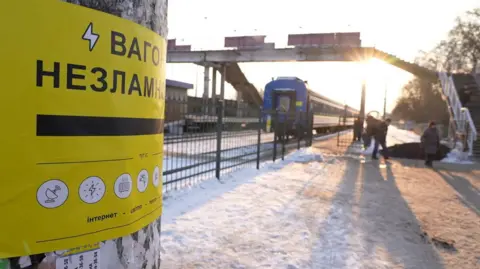
At a suburban Kyiv railway station, two carriages painted in the blue and white livery of Ukrainian Railways sit on the main platform, their diesel engines running as snow steadily falls. The train is not going anywhere but it is providing a vital service for dozens of people who have been left without power and basics like running water or heating.
These are Ukraine's 'Invincibility Trains', designed to boost public morale and provide some comfort as a bitter winter coincides with intensifying Russian attacks.
In one of the carriages, Alina sits watching her infant son Taras playing with toys provided by international charities who help run the service.
'It's winter and it's rather cold outside,' says Alina which is something of an understatement. With the effect of the wind-chill, temperatures this week in Kyiv have hit -19C. It is bitterly cold.
'I live in a new building on the 17th floor, but we have no elevator, no electricity and no water supply,' says Alina. As Taras plays with his toys, she says it is also a relatively safe and comfortable place for her daughter to meet friends.
It is also a welcome distraction for Alina, whose husband works all day in a factory, but she suddenly starts to stutter and weep as she tells me about her 54-year-old father who was killed at the front two years ago in a summer offensive near Bakhmut.
As she regathers her composure, Alina says she will definitely come back here and welcomes the relief the train brings from the weather and the nightly Russian strikes.
Ukraine's President Volodymyr Zelensky has accused Russia of deliberately exploiting the bitter winter to target power stations, energy storage facilities and other critical infrastructure. Kyiv's Mayor, Vitali Klitschko, somewhat controversially this week also suggested that city residents, who could, should leave Kyiv to help ease pressure on critical resources.
Despite such obvious hardships, most people here in Kyiv remain stoic and are prepared to put up with them.
For Yulia Mykhailiuk, Ihor Honcharuk and their one-year-old son Markiian, that means heating building bricks on a gas stove to try to warm up the rest of their small apartment. The flat, in an old Soviet-era apartment block on the east side of the Dnipro river, is a temporary move because their own home was partially damaged in a Russian attack last August.
'We've had electricity today for something like four minutes,' Ihor tells me. 'All of our charging stations and power banks have no energy left in them.'
'For the first time in a while we have a real winter in Ukraine,' says Yulia somewhat ironically. 'With this -12 to -16 cold and no heating, the apartment gets cold pretty soon.'
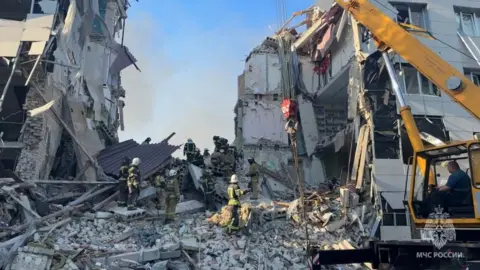
The energy crisis is not the only reason to move. Just across the courtyard from their new, temporary home, a recent Russian drone strike hit an apartment block, badly damaging several homes.
Kyiv's problems are exacerbated by the fact it has borne so many Russian airstrikes against homes and critical infrastructure installations and, as home to more than three million people, the power shortages impact many people.
The most recent Russian attacks against energy installations in the capital and other big cities have had a cumulative effect that is much worse than before.
On another bitterly cold morning, engineers are working round-the-clock to locate and repair damaged power cables servicing big residential blocks. The city authorities have urged residents not to use high-energy consuming devices to avoid overwhelming the already struggling power grid.
In a city gripped by cold and conflict, the 'Invincibility Trains' continue to symbolize resilience and the determination of its citizens to endure despite their challenging circumstances.