
In brief
The recent conflict between Israel and Hezbollah has left numerous businesses in southern Beirut devastated, with owners like Ibrahim Mortada and Imad Abdelhak unsure of their future as they deal with substantial losses. Although a ceasefire offers some respite, the path to recovery remains fraught with uncertainty.
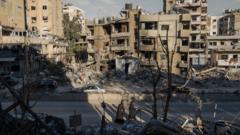
Wedged among the ruins of southern Beirut, businesses lay in shambles following extensive bombings by Israeli forces. One shattered sign reading “Spare parts. Jeep Cherokee” symbolizes the once-thriving car parts dealership that now contributes to the rubble-strewn landscape of Dahieh, a Hezbollah-controlled suburb.Imad Abdelhak, a local garage owner, reflects on the devastation with disbelief. “We didn’t think we would be hit; we are ordinary businesspeople,” he states as he contends with the potential for his garage to be razed due to structural damage from nearby strikes.The repercussions of the conflict, which recently saw a US- and French-mediated ceasefire, weigh heavily on business owners throughout Lebanon. The intense aerial assault has demolished shops and warehouses alike, leaving many without income or means to survive. Ibrahim Mortada, another car parts dealer, voices his despair: "I have lost $20,000 and my only source of income,” he laments, expressing uncertainty about the future.As Mortada surveys the unsafe remains of his establishment, he helplessly clears debris from the site where he operated for 23 years. "We are counting on God to help us now,” he adds, revealing the emotional toll the destruction has taken on his spirit.In more southern regions like Nabatieh, the damage is equally severe, with historic markets and shops reduced to heaps of rubble. Niran Ali, who owned a children's clothing shop, sifts through her lost stock to find a single pink item amidst the wreckage and reflects, “Maybe this is the only thing left of my business.”Hezbollah has promised to evaluate the damage and provide financial aid to aid in recovery efforts. This includes pledges of $5,000 for households and $8,000 for businesses to recuperate lost assets. Yet, for many business owners, as they await assistance, a sense of desperation fills the air.Jalal Nasser, who once ran a café and library complex, stands in disbelief as he estimates losses of up to $250,000. “We are waiting for Hezbollah; I’m sure they will give,” he hopes, despite the uncertainty surrounding reconstruction funding.According to the World Bank, the airstrikes have inflicted around $8.5 billion in damages to Lebanon’s economy, compounding the struggles from the prior financial crisis and the catastrophic port explosion that struck in 2020. Environment Minister Nasser Yasin acknowledges the devastation, noting that responses from regional allies remain unclear.The ongoing plight of Lebanon's businesses serves as a heartbreaking narrative of resilience against a backdrop of destruction. As uncertainty looms, both the local populace and business owners hold their breath, waiting for aid and hoping for revitalization despite the uncertainty of their path forward.


