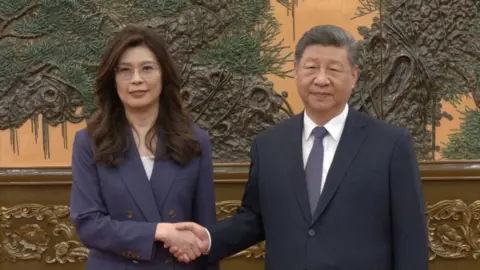
In 2024, during a historic meeting in Beijing, President Xi Jinping engaged in dialogue with a former Taiwanese leader, marking a significant moment in cross-strait relations. Among the attendees, one figure stood out for his composure and confidence: Wang Huning, Xi's chief ideological adviser. Known for his scholarly disposition, Wang's relationship with Xi illustrates the unique dynamics within the upper echelons of Chinese leadership.
Wang's presence during these discussions, especially as he sat comfortably next to Xi while others maintained formal distances, indicates his importance within the ruling elite. Professor Chiu Kun-hsuan, who was part of the Taiwanese delegation, emphasized Wang's unwavering trust from Xi, suggesting that while Wang traditionally influenced ideology, his role has expanded under Xi's centralized governance.
The intricacies of Chinese politics often lead the global community to primarily observe Xi Jinping's moves. However, Wang's enduring position through successive administrations and his ability to remain impactful without holding provincial governance sets him apart. His influence is particularly noteworthy as he has advised three prominent leaders over three decades, showcasing a profound ability to adapt and thrive within China's political landscape.
Wang's recent activities surrounding Taiwan suggest a pivot for China as it seeks to unify the island under its governance. His insights into ideology and governance may prove crucial in these efforts, reflecting a strategic alignment with Xi's broader vision for China's future influence in Asia. As the world watches closely, Wang Huning's actions and strategies regarding Taiwan could reshape not only Sino-Taiwanese relations but also the broader geopolitical landscape in the region.