In brief
As India prepares to mark its 77th Republic Day on January 26, the event symbolizes much more than a national celebration. With European Commission President Ursula von der Leyen and European Council President António Costa attending as chief guests, this year's parade highlights India's focus on strengthening ties with the European Union. The selection of invitees traditionally serves as an indicator of India's foreign policy directions, shedding light on the evolving relationships with nations across the globe.
India will mark its 77th Republic Day on 26 January - the day when the country adopted its constitution and formally became a republic, breaking from its colonial past.
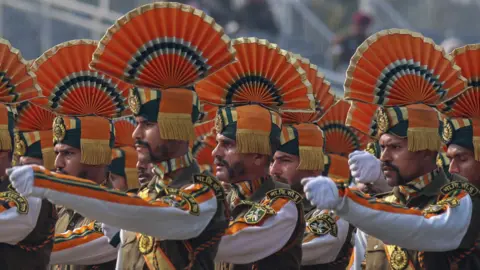
The annual grand parade will take place along Delhi's iconic central boulevard, with military tanks rolling past and fighter jets roaring overhead as thousands watch.
The parade is a spectacle in itself, but attention is also focused on who is occupying the most prominent seats at the ceremony. This year, it will be European Commission President Ursula von der Leyen and European Council President António Costa.
India has invited them as chief guests for the celebrations, placing the European Union at the centre of one of the country's most prestigious state events.
On this day, India turns the heart of its capital into a stage. Thousands of troops march before cheering crowds, armoured vehicles move down the Kartavya Path (formerly Rajpath or King's Avenue) and colourful tableaux or floats pass by spectators in Delhi, while millions more watch on their screens across the country.
The parade is presided over by the Indian president, with the chief guest seated alongside - closer to the presidential chair than even the senior-most government officials.
Who sits next to India's president has long been read as more than a matter of protocol. Over the decades, the choice of chief guest has come to be closely watched as an indicator of India's foreign policy priorities and the relationships Delhi wants to highlight at a particular moment, experts say.
The practice began in 1950 with the then Indonesian president, Sukarno, attending India's first Republic Day parade. In its early years as a republic, India prioritised ties with other newly-independent countries - a focus reflected in its early choice of chief guests.
Since then, the parade has hosted leaders from across the world, reflecting shifts in India's global relations and strategic priorities. The chief guests have come from leaders of neighbouring countries - such as Bhutan and Sri Lanka - to heads of state and government from major powers, including the US and the UK.
The UK has featured as the chief guest five times - including Queen Elizabeth II and Prince Philip - reflecting the long and complex history between the two countries. Leaders from France and Russia (formerly Soviet Union) have also been invited nearly five times since 1950, reflecting India's long-standing strategic ties with the two countries.
A foreign policy analyst noted that the evolving list of chief guests mirrors India's changing engagement with the world, with this year’s EU delegation reflecting a doubling down on engagements with Europe.
Ultimately, India's Republic Day serves as both a celebration of its identity as a constitutional democracy and a critical lens through which we can gauge its diplomatic relationships and priorities.