In brief
On 7 September 2026, a massive crowd assembled in Belgrade for the funeral of Ratko Mladić, a former Bosnian Serb general convicted of genocide. While many Serbs view him as a national hero, the European Union condemned any celebration of his legacy. The event highlighted the deep divisions within Serbia over its wartime past and its ongoing EU accession prospects.
Thousands of people turned out in Serbia's capital, Belgrade, to attend the funeral of Ratko Mladić, the convicted war criminal known as the "Butcher of Bosnia."
Mladić, 84, died while serving a life sentence in the UN prison in The Hague after being found guilty of genocide for orchestrating the 1995 Srebrenica massacre—a horrific killing of around 8,000 Bosniak men and boys, Europe’s darkest atrocity since World War Two.
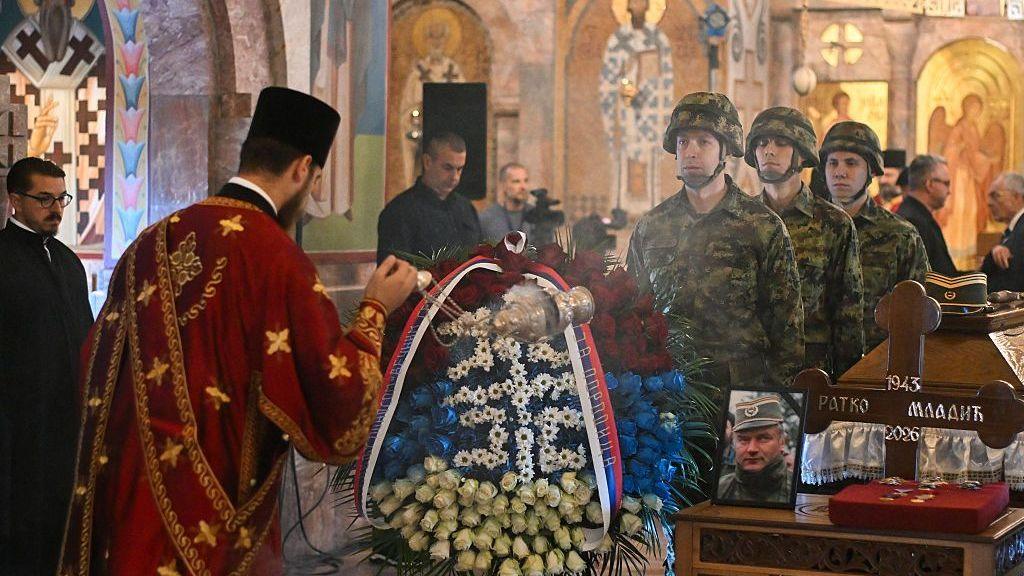
The funeral was held outside St. Luke church where the coffin lay in state. A Serbian Orthodox priest blessed the coffin, and the church’s interior was guarded by veterans. Government ministers, including Defence Minister Bratislav Gašić and Justice Minister Nenad Vujić, joined the grieving crowd.
Figure 1: An Orthodox priest blesses the coffin of Ratko Mladić at St. Luke church.
The event was marred by controversy. Serbia’s government had initially promised a state funeral, but EU officials withdrew support after objections from several European leaders. On Monday, the European Commission condemned the glorification of the war criminal, emphasizing that such acts contradict core EU values.
Despite the EU’s stance, many Serbs saw Mladić as a symbol of national pride, especially in the Bosnian Serb entity of Republika Srpska. The funeral ignited bitter memories for Bosnian civilians: a mother from Sarajevo, whose son was killed during the siege, said it was “really horrible" that the funeral took place in Belgrade.

Figure 2: Thousands queue for a public memorial during the funeral.
The funeral underscored the difficulty post‑conflict societies face in reconciling past atrocities with present identities. Critics argue that Serbian media often portray Mladić merely as a loyal soldier, while the war crimes tribunal provided detailed documentation of his crimes.
A notable flare-up occurred on the night before the funeral, when Red Star Belgrade supporters staged a tifo depicting Mladić during the Serbian SuperLiga fixture against Partizan Belgrade—a gesture that further polarized fans and drew international scrutiny.
The proceedings, attended by thousands and televised worldwide, will likely influence Serbia’s delicate relationship with the EU, where membership talks have stalled since 2012. The funeral of the notorious war hero highlights the deep, unresolved wounds of the Bosnian war and the complex path Serbia faces towards European integration.