In brief
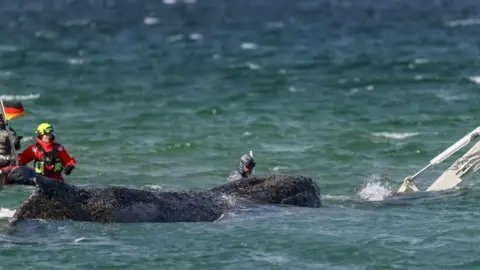
Rescuers are desperately trying to save a stranded humpback whale off the German coast. The marine mammal, estimated at 12 to 15 meters long, was first spotted in Lübeck Bay and had become stuck on a sandbank. Despite the challenging conditions, efforts to dredge a channel for the whale to reach deeper waters are underway, attracting considerable attention online. Experts suggest the whale may be in distress, having not fed for days and possibly entangled in fishing nets. While prospects for its rescue seem slim, rescuers remain hopeful.
Rescuers are continuing to try and save a stranded humpback whale off Germany's north coast. The marine mammal, which is stuck on a sandbank, was first spotted in Lübeck Bay on Monday. Diggers have been deployed to dredge a channel back into deeper waters. Characterised as a race against time, the rescue mission is attracting huge interest and is even being livestreamed from Timmendorfer Strand, a seaside town in Schleswig-Holstein. Estimated to be 12 to 15 meters long and weighing around 15 tons, the whale may have become entangled in a fishing net, with rope still stuck in its mouth. Experts believe it's a young male that may have accidentally wandered into shallow waters, though it remains unclear why it became stranded. Warnings indicate that the chances of saving him are very slim, but rescuers aren't giving up. For the whale, this is obviously a stressful situation, said Stephanie Gross from the Institute for Terrestrial and Aquatic Wildlife Research. He's been here in the shallow water for three days now and isn't feeding at all at the moment, although animals can go without food for weeks. Conditions at the seashore are tough due to an icy easterly wind, and the heavy, weakened creature poses additional challenges for the divers who have been able to get close. Marine biologist, Robert Marc Lehmann, stated the whale's skin looks terrible, but it is responsive and vocalizing. Other rescue efforts using high tide to push the whale back into the sea have failed so far. Nonetheless, hope remains that the dredged channel will encourage it to swim away or, if necessary, a gentle nudge will help it back to deeper waters.