In brief
Japan’s MMX mission has launched a spacecraft that will reach Mars’ smaller moon Phobos in August 2027. It will deploy a rover to locate a safe landing site, then return a tiny sample of moon dust to Earth by 2031. Scientists expect the 10‑gram payload to reveal whether Phobos originated from a catastrophic impact or from captured asteroids. This mission marks the first time material from Mars or its moons will be brought back for laboratory study.
A new spacecraft has blasted off from Japan and is on its way to Mars’s tiny moon Phobos, carrying a heart‑shaped capsule that will hold 10 grams of moon dust for return to Earth.
If the mission succeeds, scientists will witness the first sample taken from Mars or one of its moons that will be analyzed on Earth. The MMX team hopes the data will unlock the mystery of how Phobos and its sibling Deimos formed.
The Mission Timeline
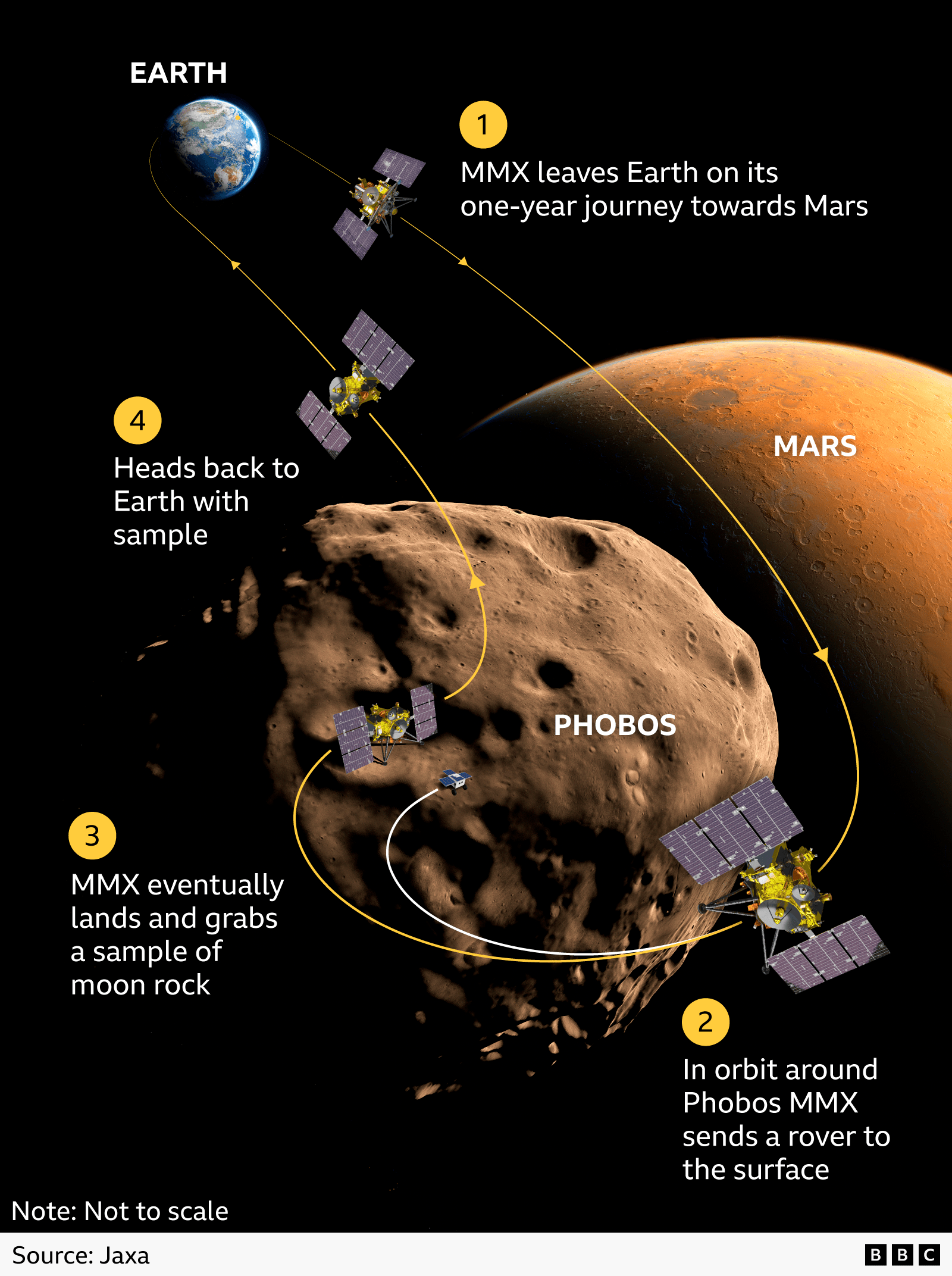
- Launch – the spacecraft left Nishiura Space Center on 19 October 2026.
- Mars Encounter – MMX will reach the Martian system in August 2027.
- Phobos Landing – a small rover will scout and secure a site for the MMX lander.
- Sample Collection – a robotic arm will scoop 10 grams of dust and seal it into a capsule.
- Return – the capsule will re‑enter Earth’s atmosphere and touch down in the Woomera desert, South Australia, in 2031.
Why 10 Grams Matters
The payload may sound tiny, yet researchers believe a few milligrams can yield rich mineralogical and isotopic data. Dr. Chrysa Avdellidou of Leicester University noted that even single grain analyses can distinguish between an impact‑derived origin and a captured asteroid scenario.
Rover and Lander Design Challenges
Phobos’s low gravity (about 0.002 g) and irregular shape pose a unique landing problem. Sara Russell of the Natural History Museum explained that a rover must firmly anchor itself to avoid bouncing away under Mars’s stronger gravitational tug.
What We Hope to Learn
The primary goal is to discriminate between two leading theories: a giant impact that shattered Mars and left debris in orbit, or capture of two outer‑solar‑system asteroids by the planet’s gravity. The dust’s chemistry, mineralogy and isotopic signature will immediately reveal which scenario is correct.
An exciting side note is that Phobos may act as a collector of grains that fall from Mars's surface during impacts. If such Martian material ends up in the sample, it could provide a direct compositional link between the planet and its moons.
The Broader Context
Since the Perseverance rover began amassing samples in 2021, several planetary bodies have been targeted for sample return: NASA’s now‑cancelled Mars Sample Return, China’s 2028 launch plan, and now Japan’s MMX. Unlike meteorite fragments that reach Earth after violent ejection, the MMX sample will be enclosed, unused, and free of Earth contamination.
Beyond science, the mission showcases international cooperation and marks a milestone for space exploration. If all goes as rehearsed, the first human‑made sample from Phobos will arrive on Australian soil in 2031.
Follow the journey in real‑time by watching the launch footage, exploring the interactive rover map, and joining live Q&A sessions with the team.
Images: Fly‑by footage and mission illustration © BBC News and NASA. Martian meteorite exhibit © Kevin Church/BBC News.