In brief
Syrian rebel leader Abu Mohammed al-Jawlani, now known as Ahmed al-Sharaa, is transitioning from his jihadist past to become a prominent political figure. This change comes as his group, Hayat Tahrir al-Sham, asserts control over Damascus, reflecting a strategy that merges governance with militant activities, while navigating local resistance and international perceptions.
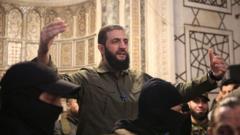
Abu Mohammed al-Jawlani, the leader of the Syrian rebel group Hayat Tahrir al-Sham (HTS), is undergoing a significant transformation, shedding his jihadist identity to present himself as a legitimate political leader. Following the anticipated collapse of President Bashar al-Assad's regime, al-Jawlani has begun using his real name, Ahmed al-Sharaa, in official communications, signaling a deliberate shift towards a political role. This transition is not spontaneous; it has been carefully crafted over several years. Al-Jawlani’s evolving public persona reflects not only his changing rhetoric but also his attire, moving from traditional militant dress to military fatigues, emphasizing his leadership in ongoing military operations. Al-Jawlani's journey began in Saudi Arabia, where he was born in 1982. Soon after, his family relocated to Syria. His early experiences in Iraq intertwined him with al-Qaeda, especially during the organization’s initial phases post-2003 invasion of Iraq. After serving time in a U.S. detention facility, al-Jawlani was dispatched to Syria with resources to form al-Nusra Front—a faction that masked its ties to al-Qaeda to gain local support. The complexities of his leadership became apparent during the 2013 split from the Islamic State (IS). After resisting IS's unilateral merger with al-Nusra, al-Jawlani pledged allegiance to al-Qaeda, further embedding his group within the region's complicated jihadist framework. However, he later sought to rebrand and distance HTS from its violent roots by establishing it as a more politically savvy group, reforming its image in 2016 and again in 2017 after severing ties with al-Qaeda. Leading HTS, al-Jawlani has sought to solidify control over Idlib, implementing a civilian administration—the Syrian Salvation Government (SG)—that mimics state structures while maintaining religious governance. His public engagement, particularly in times of crisis, has attempted to showcase HTS's governance capabilities and ensure local support. However, his leadership has faced scrutiny for alleged authoritarianism, with numerous protests arising against HTS's suppressive tactics. Despite the challenges, including ongoing anti-HTS protests, al-Jawlani’s recent military successes have bolstered his position. The conflict's dynamics have pushed him to assure local stakeholders of security and unity, while reaching out to international powers, including Russia, to foster peaceful relations. This strategy reflects a broader shift in HTS's operational philosophy since the split from al-Qaeda, emphasizing local governance and stability over rigid jihadist doctrines. It hints at a potential evolution in jihadist movements—one that may prioritize pragmatism over extremism and redefine the parameters of local governance in war-torn Syria. The unfolding events in Syria could signal a transformative period under al-Jawlani’s leadership, where aligning militant actions with political ambitions may create a new chapter in the ongoing conflict landscape.