In brief
In a first face-to-face meeting, Colombian President Gustavo Petro is set to discuss pressing issues with US President Donald Trump, including Venezuela, drug trafficking, and US military actions. Both leaders have exchanged critical remarks, but recent phone conversations have paved the way for a more cooperative dialogue. This visit holds significant implications for Colombia's future relationship with the US as Petro prepares to leave office.
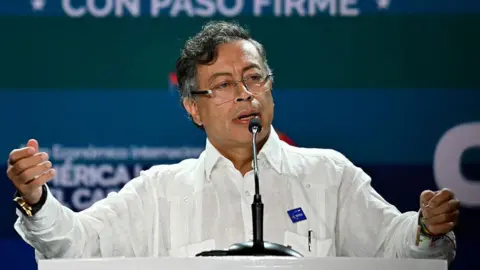
Colombian President Gustavo Petro is heading to Washington for a high-stakes trip to meet US President Donald Trump, the first in-person meeting between the two after months of escalating tensions and angry rhetoric.
Venezuela, drug trafficking, oil, security, and US strikes on alleged drug vessels will be high on the agenda when they meet at the White House on Tuesday.
While the two men were cordial in a phone call after the 3 January US military operation to seize Venezuela's President Nicolás Maduro, Petro has since said he believes that there is a real threat of military action against Colombia.
Trump, for his part, has previously said that a military operation in Colombia sounds good. Tuesday's meeting follows months of the two leaders trading barbs - with Petro repeatedly criticising the repeat US strikes on the alleged drug boats in the Caribbean and Pacific, as well as the White House's immigration policies.
In an interview with the BBC last month, Petro went as far as to compare US Immigration and Customs Enforcement (ICE) agents to Nazi brigades and accused the US of treating other countries as part of its empire.
On the US side, Trump has accused Petro's government of not doing enough to stop the flow of cocaine heading north, and has vowed to expand strikes to land targets across the region.
But the acrimony seemed to dissipate following a cordial phone call between the two leaders, which a Colombian official later described as an 180-degree turn from both sides. According to diplomatic sources, one man - Rand Paul, US Senator for Kentucky - was instrumental in setting up the conversation. I believe in diplomacy and I thought our relations were going in the wrong way, the senator told the BBC. And I'd like to see our relations improve. Paul added that he believed the upcoming meeting in Washington could build on the earlier dialogue between the two men.
Ahead of Tuesday's visit, Colombian Foreign Minister Rosa Yolanda Villavicencio said that much of the conversation would focus on shared US and Colombian concerns over security in Venezuela, with which Colombia shares a 1,367 mile (2,200km) border. Much of that border is under the sway of the National Liberation Army, or ELN, which controls drug trafficking and illegal mining.
Elizabeth Dickinson, deputy director for Latin America at International Crisis Group, stated that addressing the threat posed by the ELN will be vital for ensuring security for US firms involved in Venezuela's oil industry. This meeting also signifies an opportunity for a strategic partnership between Trump and Petro.
Despite existing tensions, cooperation continues between the militaries of both nations and the US Drug Enforcement Administration (DEA) and Colombian police. Colombian officials have indicated that the visit will allow them to showcase their counter-narcotics efforts to a skeptical White House.
Conclusion: The upcoming meeting is not just a diplomatic formality; it holds the possibility of reshaping the dynamics of US-Colombian relations. For President Petro, the stakes are particularly high as he approaches the end of his term and seeks to leave a lasting impact on Colombia's international partnerships.