In brief
A week‑long wave of demonstrations drove nearly 1,000 arrests in France, as protestors took to streets from Paris to Marseille. Police dispersed crowds with tear gas and water cannon, burning makeshift barricades in Marseille and vandalising a shop in Bordeaux. While the unrest did not reach the scale of last weekend, it highlighted deep frustrations over cost of living, educational cuts and perceived political neglect. President Macron’s recent decree limiting marches to recognised unions increased tensions, and European cities saw similar protests erupting in Brussels and Milan.
Paris, Marseille and beyond: 1,000 arrests in France’s escalating protests
Hundreds of thousands of citizens marched across France on Saturday, culminating in nearly 1,000 arrests, according to the Interior Ministry. While the battle lines were drawn by student demands on one side and political crack‑downs on the other, the visual tableau of burning barricades and tear‑gas plumes painted a stark picture of a nation in turmoil.
The conflict began evenly. A largely peaceful march through Paris’s Porte d’Italie slid into skirmishes against riot police as the route approached Porte de Vincennes. The police, reinforced by an elite counter‑terrorism unit, responded with baton charges and tear‑gas grenades, leading to blockades that were abandoned after fire was set in Marseille’s southern port. Bordeaux residents took boards from a shop, constructing a makeshift street barricade that eventually sparked into flame.
In Lyon, police units deployed tear‑gas canisters to break up a gathering of secondary school and university students who had assembled outside a venue deemed off‑limits by the prefecture. Reports from the city centre noted that.
In an arena less often highlighted, a masked protester in Paris voiced frustration: "I do not want another dissolution," he told reporters, adding that the protestors feel abandoned by Macron’s administration. The same sentiment echoed across the country, reflected in the voices of an older woman named Zelie, who described her generational despair.
With 70,000 police officers mobilised in several cities, the French authorities aimed to prevent a repeat of last week’s chaos, which saw riot police outnumbered and shops looted on an unprecedented scale. Yet the police did not escape injury: two officers were seriously hurt in Toulouse and in Clermont‑Ferrand, and roughly 1,000 officers sustained minor wounds.
A request from President Macron to limit demonstrations to recognised trade‑union organisers has intensified the friction, causing a wave of fast‑track court hearings that have jailed many vanguard activists for vandalism and looting. The authorities have imposed overnight curfews in Paris and other major cities.
It is early days in what could be a marathon of the public: France’s presidential election lies six months away, and the political stakes are high. The polarisation over who is to blame for the disturbances is reflected in disputing narratives—Macron supporters attack oppositional groups, critics in turn blame a perceived disconnect between elected officials and ground realities.
Outside France’s borders, alarmed European capitals mirrored the unrest. In Brussels, ant‑government forces met tear‑gas fire as police closed ranks; Milan’s security forces, fearing a repeat of last weekend, blocked a protest route that had once seen fires, smashed windows, and looted stores.
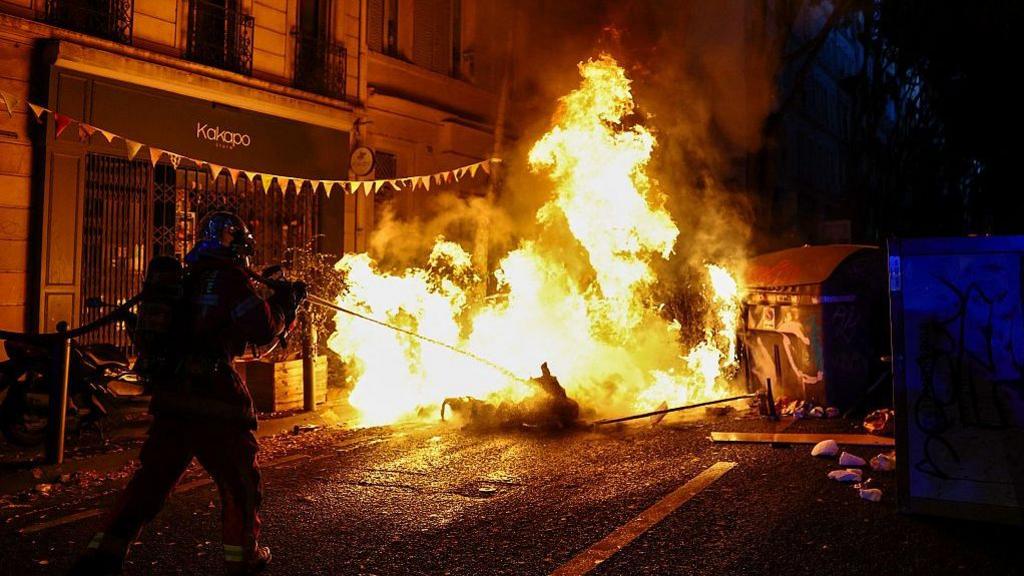
The cost is badly visible; at least 2,000 shops across France suffered damage, with the French Chambers of Commerce and Industry estimating the financial toll at hundreds of millions of euros. Amid the fallout, a photograph captured from the scene in Marseille: a burning barricade, etched with the sizzle of flames and the chaos of the gathered crowd.
As the protests continue, the trajectory remains uncertain. Whereas avoidance of widespread looting marks a partial success, the sharp splinter between the state and the public continues to widen—posing questions for France, and the rest of Europe, on how to reconcile civic dissent with stable governance in an era of social frustration.