In brief
On April 23, 2026, two trains collided head-on near Hillerød and Kagerup, about 40 km northwest of Copenhagen, injuring 18 people, five of whom are in critical condition. Investigations into the cause are underway, with authorities looking at potential signaling failures and human error as contributing factors.
In a tragic incident on April 23, 2026, two trains collided head-on at a level crossing northwest of Copenhagen, leaving five individuals critically injured and 13 others suffering less severe injuries, as reported by medical officials.
The collision took place early Thursday morning on a railway line that connects the towns of Hillerød and Kagerup in the North Zealand area, with a total of 37 passengers on board, according to police statements.
Tim Ole Simonsen from the Greater Copenhagen fire department stated that the exact cause of the crash remains unclear. All injured parties were transported to hospitals via airlift and ambulances.
Local mayor Trine Egetved expressed her shock over the accident, stating that the local train line is frequently utilized by residents, workers, and students.
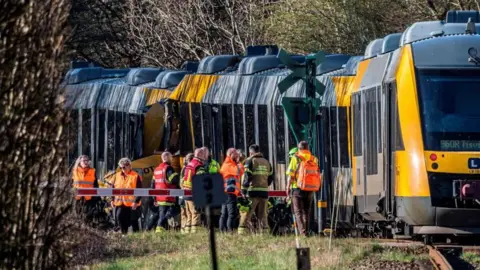
Images from the scene depicted the two trains, visibly damaged, facing each other amid woodland surroundings. The accident occurred at 06:29 local time (05:29 BST) and emergency services were called to the scene promptly.
Egetved shared on social media her distress regarding such a collision occurring and emphasized the need for assurances that similar incidents would not happen again.
Prime Minister Mette Frederiksen expressed her concerns about the tragedy in a statement to the government-owned broadcaster TV2.
The Denmark Accident Investigation Board arrived at the crash site to begin an inquiry. Inspector Morten Pedersen of the North Zealand police cautioned that it is too early to determine what caused the accident.
Investigators are examining all possibilities, including potential failures in the signaling systems and human error. Claus Pedersson, the safety director at Lokaltog, which operates the railway line, condemned the events as one of the ‘worst’ imaginable in the realm of railway incidents.
Pedersson reported that one train driver managed to apply the brakes and assisted with the evacuation of passengers. As rail accidents are rare in Denmark, experts speculated that a train driver’s error, possibly in overriding a stop signal, may have contributed to the crash, noting that the Gribskov line might lack updated automated safety systems.